TL;DR: Subscription alternative platforms provide legitimate access to software through shared subscriptions or short-term activation codes, aligning usage with actual need.
Introduction
Many modern software tools are distributed exclusively through monthly or annual subscriptions. While suitable for continuous users, this model creates friction for individuals who only need a tool occasionally, such as completing a report or a short project.
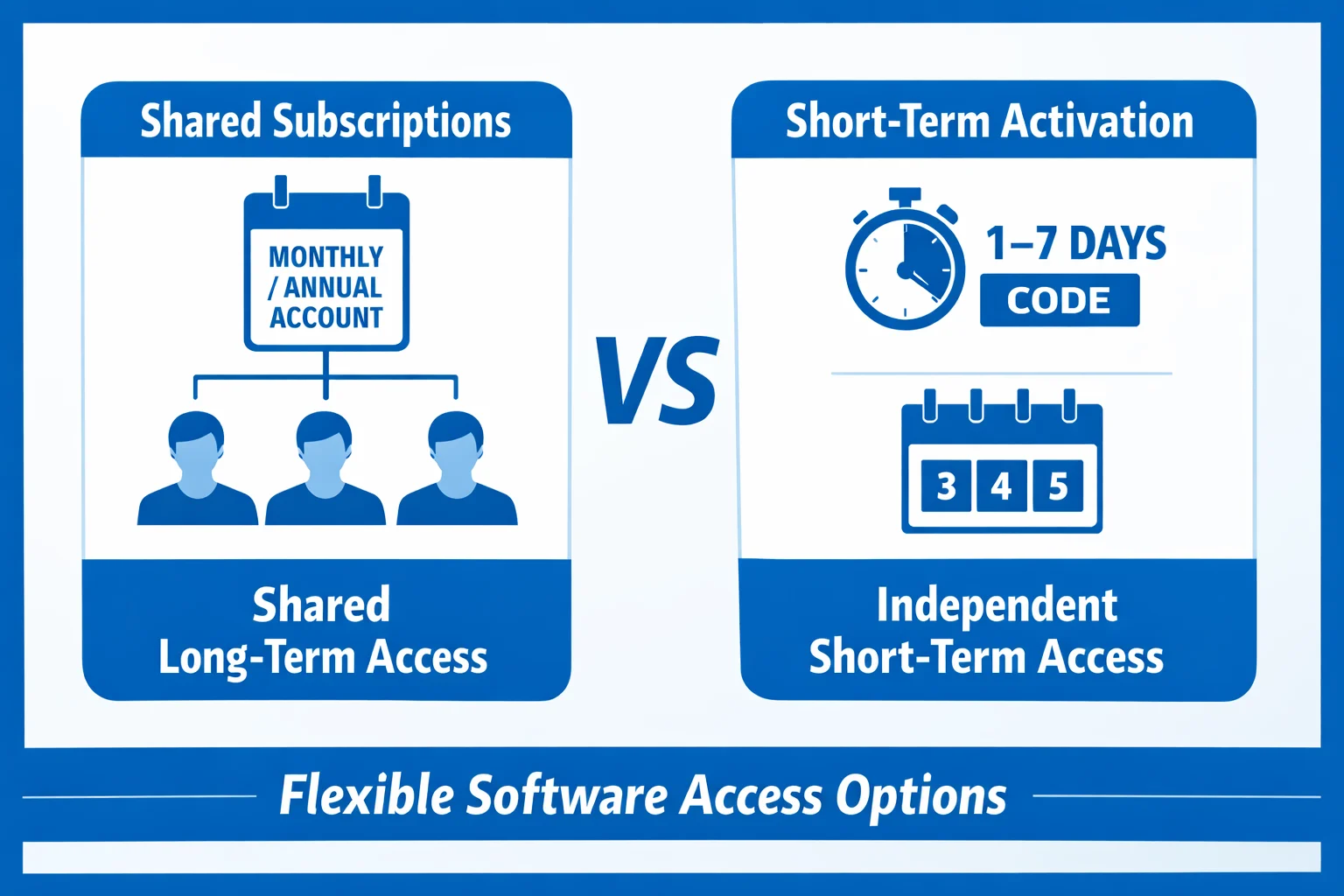
In practice, the term “subscription alternative platform” covers different types of access models. Many platforms reduce cost by sharing official monthly or annual subscriptions, while a smaller category offers true short-term access through time-limited activation mechanisms. Understanding this distinction helps prevent confusion between shared subscriptions and genuinely short-term usage.
Subscription alternative platforms aim to provide flexible software access without requiring a long-term commitment, though the nature of that flexibility varies widely between platform types.
Core Access Models Used by Subscription Alternatives
Subscription alternative platforms do not rely on a single access model. Most platforms fall into two clearly different categories: platforms based on shared official subscriptions (monthly or annual), and platforms that provide true short-term access via time-limited activation codes. Treating these models as equivalent can misrepresent cost, duration, and compliance.
Common access models
| Access model | What it actually provides | Market reality |
|---|---|---|
| Shared or pooled subscriptions | Access to an official monthly or annual account shared across users | Most common |
| Time-based activation codes | Independent access valid for 1–30 days | Limited to specific platforms |
| Usage-based credits | Limits actions rather than time | Niche / tool-specific |
| Cloud-mediated feature access | Feature gating via server | Common in SaaS |
| Hourly access | Rare and often impractical | Uncommon |
Key point: Shared subscriptions do not create short-term licenses. They divide the usage of a monthly or annual subscription, whereas day-level access is typically available only through time-limited activation code systems (ShortKey short-term activation codes explanation).
How to verify success
- Confirm expiration or remaining usage counter inside the software.
- Check that premium features are available only during the active window.
Troubleshooting tip
- If access does not expire as expected, log out and re-authenticate to refresh the license.
Technical Mechanisms Behind Access Control
Subscription alternative platforms enforce limits through standard licensing techniques rather than informal workarounds. Access is granted only when the platform confirms that time or usage limits have not been exceeded.
Typical access flow
- Request: Activate access via an account login or activation code.
- Validation: Software or client contacts a licensing server to verify eligibility.
- Token issuance: A time- or usage-bound license token is issued.
- Access: Premium features unlock while the token remains valid.
- Expiration or revocation: Features revert automatically once limits are reached.
License tokens may include timestamps, device identifiers, and feature flags. Platforms rely on server-side validation, device binding, session control, and logging to prevent misuse (Software licensing models education (Nalpeiron)).
How to verify success
- Inspect license status or timestamps within the software’s account or “About” panel.
- Confirm features automatically revert after expiration.
Troubleshooting tip
- Ensure system time is accurate, as time-based validation can fail if device clocks are incorrect.
Pricing Logic and Cost Optimization
The pricing logic focuses on short-term value rather than continuous availability. Users pay based on actual access rather than ongoing subscription cycles.
| Usage pattern | Annual subscription | Short-term access |
|---|---|---|
| One 3-day project per month | High unused cost | Pay only for the active days |
| Quarterly report editing | Mostly idle | Access only when needed |
| Daily professional use | Predictable | Subscription often cheaper |
Short-term platforms are viable because they pool demand or resell predefined access windows (Pricing Models Explained: Usage-Based vs Subscription Pricing (Zylo)). Subscriptions remain more economical for daily or unpredictable workloads.
How to verify success
- Calculate effective cost per active day or per task.
- Compare with the vendor’s subscription pricing.
Troubleshooting tip
- Check for hidden auto-renew settings and confirm purchases are one-time.
User Experience and Practical Workflow
User workflows differ by platform type.
- Shared-subscription platforms: Users gain temporary access to an official monthly or annual account, complete work, then log out without owning the subscription.
- Short-term activation code platforms: Users activate an independent license for a defined period, such as three or seven days, after which access expires automatically (Short-Term AI Activation Keys guide).
Both approaches work across Windows, macOS, and web-based tools. Data is generally preserved locally or in user cloud storage, though premium features may be disabled after expiration.
How to verify success
- Confirm files remain accessible after license expiry.
- Ensure no background services or sessions remain active.
Troubleshooting tip
- Export or back up files before expiration to avoid read-only limitations.
Frequently Asked Questions
Are subscription alternative platforms legal?
They are legal when access is granted through authorized licenses, resale agreements, or compliant pooling models that respect the software vendor’s terms.
Legality depends on how the platform sources and manages licenses. Some resell official time-limited activation keys; others operate shared-license systems permitted under enterprise agreements. Avoid platforms distributing modified executables. Refer to licensing documentation such as Software Licensing Models: Your Complete Guide (Revenera) for compliance guidance.
Do these platforms provide full-feature access?
Most provide full premium functionality during the active period, with limits applied only to time, usage, or concurrency rather than features. Short-term access often mirrors a standard subscription, though cloud sync or updates may be restricted.
What happens to my files after access expires?
Files generally remain intact, but editing, exporting, or premium processing may be restricted. Export final versions beforehand and verify ownership policies.
Who benefits most from subscription alternatives?
Occasional users, freelancers, students, and small teams with project-based or infrequent software needs benefit most.
Users seeking true short-term access measured in days should note that most subscription alternative platforms do not offer this directly; such access is usually provided by platforms specializing in time-limited activation codes (Short-term activation codes vs shared accounts).
Legality & Risks
Subscription alternative platforms vary in reliability and compliance. Risks include unauthorized license resale, sudden access revocation, or incompatibility after updates. Users should avoid services that distribute cracked software. Reviewing platform transparency, licensing explanations, and support responsiveness reduces risk (Software licensing models education (Nalpeiron)).
Conclusion
Subscription alternative platforms reduce cost in two fundamentally different ways:
by sharing official monthly or annual subscriptions, or by offering independent, time-limited activation access. Understanding which model a platform uses is critical, as only the latter provides true short-term usage without relying on shared accounts. Users can then choose software access aligned with actual usage, costs, and compliance requirements.