
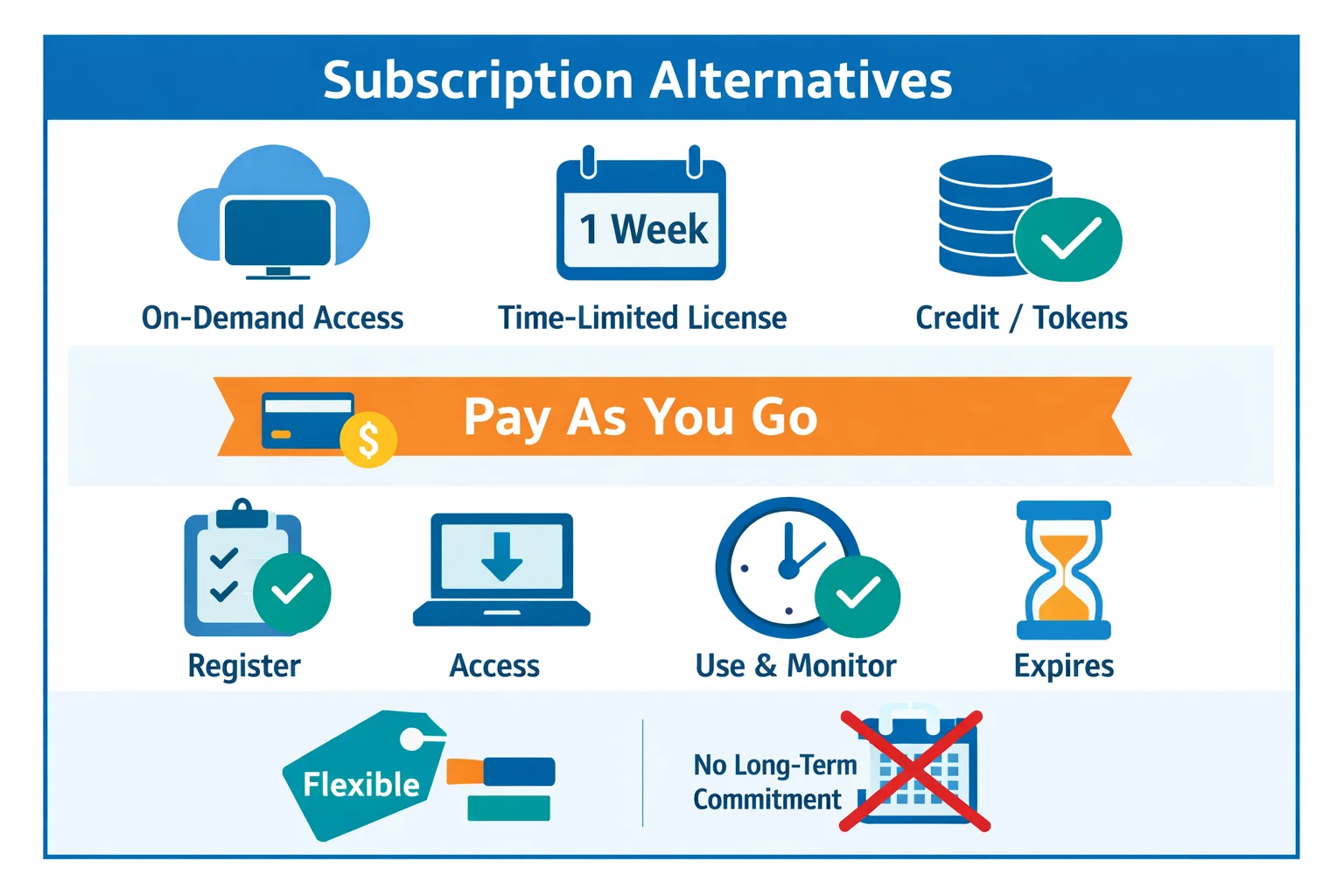
TL;DR: Subscription alternative platforms provide temporary, usage-based, or time-limited access to software, offering flexible options beyond traditional recurring subscriptions.
Introduction: Understanding Subscription Alternatives
Traditional subscription models typically require users to commit to monthly or annual fees, often leading to underutilization or unnecessary costs. However, many individuals and businesses encounter situations where access to specific software or services is needed only for a short period. Subscription alternative platforms address this gap by offering temporary or usage-based access, aligning payment with actual need rather than fixed recurring periods.
Users and organizations often face challenges when software subscriptions do not match project timelines. Freelancers may need design tools for a week-long campaign, seasonal accountants may require tax software only during tax season, and temporary staff may need analytics tools for limited assignments. These scenarios create demand for flexible access options that reduce financial commitment while ensuring full functionality.
By providing short-term access solutions, these platforms also cater to specific user segments that are cost-sensitive or require specialized tools without ongoing obligations. Industry reports indicate that the SaaS market is increasingly recognizing these needs, with more platforms adopting usage-based or time-limited licensing models.
How Subscription Alternative Platforms Operate
Subscription alternative platforms operate by offering controlled, temporary access to software or services through various mechanisms. Unlike recurring subscriptions, these platforms often rely on usage-based billing, pay-per-use systems, or time-limited licenses. The core workflow typically involves four steps: registration, payment, access provision, and expiration.
Platform Types
- On-demand software access: Users gain temporary access to full-featured software without installing long-term licenses. This model is common for cloud-based tools and virtual environments.
- Single-purchase or time-limited licenses: Users purchase access for a defined period, such as a week, month, or specific number of sessions.
- Credit- or token-based systems: Platforms provide credits or tokens that can be redeemed for software usage, allowing granular control of access.
Technically, these platforms verify access through server-side license checks, user authentication, and automated expiration mechanisms. Users receive confirmation of activation, duration, and expiry, and many platforms provide dashboards to track usage. Troubleshooting typically involves re-verifying license status, clearing cache or cookies, or contacting support if access fails.
Authoritative explanations of these models can be found in industry resources like Usage-Based Pricing explained and Salesforce's guide to usage-based pricing.
Benefits Compared to Traditional Subscriptions
Subscription alternatives offer several advantages, particularly for short-term or project-based use:
| Feature | Traditional Subscription | Subscription Alternative |
|---|---|---|
| Cost | Recurring monthly or annual fees | Pay-per-use, single purchase, or time-limited |
| Duration | Ongoing until canceled | Flexible, defined access period |
| Commitment | Long-term | Low or no long-term obligation |
| Use Case | General ongoing work | Temporary projects, seasonal tasks, freelance assignments |
These platforms provide flexibility by allowing users to pay only for what they need, reducing unused software costs. Reduced commitment risk ensures that users are not tied to long-term contracts, making it ideal for students, freelancers, and temporary staff. Financial analyses and user surveys consistently indicate that short-term access models improve efficiency and lower unnecessary expenses for intermittent software usage.
Common Use Cases and Examples
Subscription alternatives are increasingly popular across several contexts:
- Short-term projects: Accessing software for a week or month without committing to recurring fees.
- Seasonal or cyclical needs: Tax preparation, graphic design, or data analytics software that is used irregularly.
- Professional freelancing: Temporary access to specialized tools enables freelancers to complete tasks without long-term subscriptions.
Example process for temporary software access:
- Identify the software and duration needed.
- Register on the platform and select a time-limited license or token bundle.
- Make payment through the platform’s secure system.
- Access the software immediately, perform tasks, and monitor usage.
- Automatic expiration ensures the license is deactivated at the end of the period.
This step-by-step workflow aligns with best practices outlined in ShortKey service overview and usage reports from SaaS case studies. Temporary access platforms typically provide notifications before expiration to avoid workflow disruption.
How Payments and Access Are Managed
Payment models in subscription alternatives vary based on usage type:
- Single-use or time-based payments: Users pay a fixed fee for a defined period.
- Credits or tokens: Pre-purchased credits are consumed as software is used.
- Usage-based billing: Billing reflects actual consumption, such as API calls, storage, or hours used, as explained in Ultimate Guide to Usage-Based Pricing.
Access control mechanisms include automatic expiration, multi-device verification, and account authentication to ensure proper license usage. Troubleshooting common issues involves confirming license status, reviewing account limits, and contacting support for unresolved access errors. Platforms like ShortKey provide explicit guidance in their Refund Policy and Terms of Service, helping users understand their rights and responsibilities.
Security, Legal, and Compliance Considerations
Using subscription alternative platforms requires attention to security and compliance:
- Data protection: Platforms implement encryption, secure authentication, and activity monitoring to safeguard user information, as outlined in the ShortKey Privacy Policy.
- Licensing compliance: Temporary access must adhere to software End-User License Agreements (EULAs), ensuring legal usage.
- Risk mitigation: Users should verify platform legitimacy, review expiration policies, and confirm secure payment processes.
Compliance with legal and ethical standards is essential, particularly when platforms offer shared or cloud-based access. Cybersecurity recommendations emphasize the importance of encrypted transactions, strong account passwords, and using trusted providers.
Comparing Subscription Alternatives
Evaluating subscription alternatives requires balancing flexibility, cost, and reliability.
| Criteria | Advantages | Limitations |
|---|---|---|
| Flexibility | Users can access software only when needed | Limited long-term features or updates |
| Cost | Pay only for usage, avoids wasted fees | May be higher per-unit cost if frequently used |
| Scalability | Easily adjust access for teams or projects | Complex management for multiple users |
| Compliance | Easier to align with project-specific needs | Must monitor license terms closely |
Choosing the right platform involves assessing affordability, platform reliability, ease of access, and compliance with legal requirements. SaaS comparison studies and expert reviews indicate that temporary access solutions are particularly effective for intermittent or specialized software use cases.
Frequently Asked Questions
What types of software typically use subscription alternatives?
Productivity, design, analytics, and specialized professional software often provide temporary access options.
Many SaaS providers recognize that users may require software only for specific projects. For example, graphic design tools, accounting platforms, or data analytics software frequently allow short-term licenses or pay-per-use access. This approach minimizes unnecessary costs while providing full functionality for the required period. Users typically follow a checklist: identify the software need, select a platform, purchase short-term access, confirm license duration, and complete the task using the software. Platforms such as ShortKey demonstrate how temporary access is implemented in practice.
How do platforms enforce temporary access?
Temporary access is managed through automatic expiration, account verification, and license key restrictions.
Platforms enforce access limitations via server-side validation, timed license keys, and device restrictions. Users are granted temporary permissions that expire automatically after the agreed period. Monitoring tools track usage to prevent unauthorized extension or sharing of access. This ensures compliance with both payment terms and software licensing agreements. Effective enforcement prevents misuse while providing a seamless experience for legitimate users, as discussed in Usage-based pricing definition.
Are subscription alternatives more cost-effective than regular subscriptions?
They are often more cost-effective for short-term or infrequent usage.
By paying only for the period or amount of software actually used, users avoid paying full-month or annual fees unnecessarily. Cost-effectiveness depends on project length, frequency of use, and the platform’s pricing structure. Users should compare total expenditures for recurring needs versus temporary access to determine the most economical approach. Studies on usage-based pricing adoption, such as Usage-based pricing growth and adoption study, support this analysis.
How do I verify the legitimacy of a platform?
Check for official documentation, privacy policies, and verified user reviews. Legitimate platforms provide clear terms of service and secure payment processing.
Can I extend or renew temporary access?
Most platforms allow renewal or purchase of additional time. Users should verify terms and expiration rules before renewal.
What happens if I need multiple users simultaneously?
Some platforms provide multi-user licenses or additional tokens. It is important to check platform capacity and pricing for team or multi-device access.
Conclusion: Key Takeaways
Subscription alternative platforms provide flexible, cost-efficient solutions for users who need temporary or usage-based software access. They operate through time-limited licenses, pay-per-use billing, or token systems, with automated access control and verification. Key benefits include reduced commitment risk, improved cost-effectiveness, and accessibility for project-based work.
When choosing a platform, users should evaluate the duration of access, pricing, reliability, and compliance with licensing terms. Implementing temporary access requires understanding payment models, platform verification steps, and security considerations. Authoritative resources, including SaaS market reports and platform documentation, can guide informed decisions about subscription alternatives.
References and Suggested Authority Sources
- Guide to short-term activation codes
- ShortKey service overview
- ShortKey Privacy Policy
- ShortKey Refund Policy
- ShortKey Terms of Service
- Usage-Based Pricing explained
- What is Usage Based Pricing? Guide
- Usage-based pricing definition
- Ultimate Guide to Usage-Based Pricing
- Usage-based pricing growth and adoption study