
As of October 2025. Policies and product behaviors change frequently—verify the latest terms with your vendor and consult your legal/compliance team for organization-specific decisions.
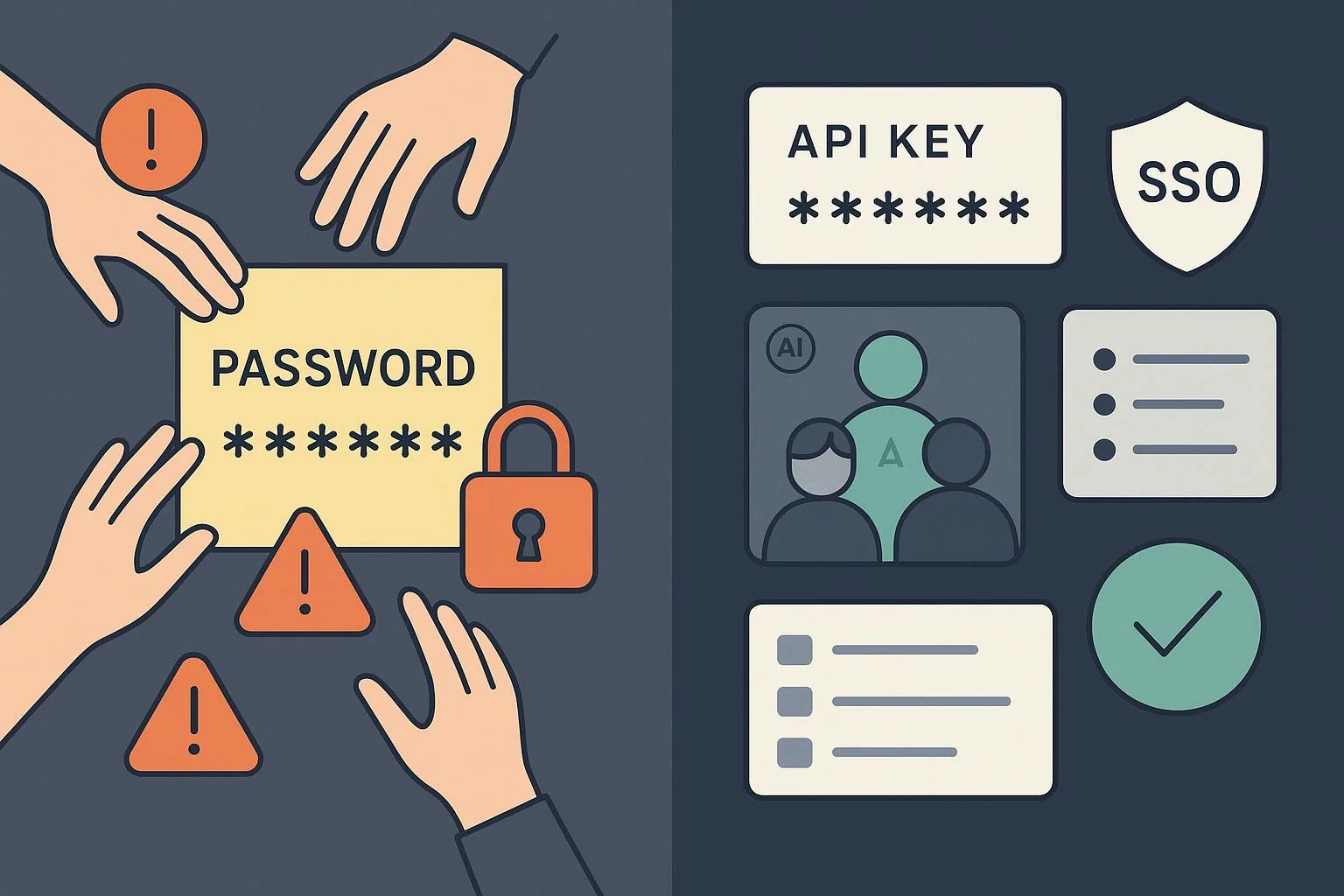
If you’re tempted to stretch a single “Pro” account across a team or buy a cheap shared login from a reseller, you’re not alone. Budgets are tight, and legitimate business/enterprise seats add up. But the compliance, security, and reliability gaps between “shared accounts” and official access (API keys and licensed team/enterprise plans) have widened in 2024–2025—and so has enforcement. This guide compares both approaches, highlights where the real risks show up, and offers safer alternatives.
What we mean by “shared accounts” vs. “official keys/plans”
- Shared AI accounts: One consumer account credential (e.g., a personal chatbot subscription) used by multiple people, or gray‑market resellers who sublease one login to many users. This typically violates provider terms.
- Official access: API keys with per-service or per-user isolation and licensed team/enterprise plans (e.g., ChatGPT Team/Enterprise, Claude Enterprise, Gemini for Workspace, Microsoft Copilot for work/education). These channels include admin controls, audit trails, and clearer data protections.
What changed in 2024–2025 (the short version)
- Terms and enforcement: Providers tightened language around credential sharing and resale and retained explicit suspension rights. For example, the OpenAI Services Agreement prohibits sharing or reselling access and allows suspension for violations and security emergencies, as stated in the OpenAI Services Agreement (2025).
- Data handling: Defaults and opt‑outs are clearer but vary by channel. OpenAI reiterates that API inputs/outputs are deleted from logs after about 30 days and business data isn’t used for training by default, per the OpenAI response to the NYT data demands (2024). Anthropic’s 2025 update notes that if a consumer user explicitly allows model improvement, data can be retained for 5 years, according to the Anthropic privacy policy update (2025). For Google’s consumer Gemini Apps, when activity is turned off, content is processed to provide the service and typically deleted within about 72 hours, as described in the Gemini Apps Privacy Hub (Google Support, 2025). The Gemini API separately keeps certain data for abuse monitoring for 55 days under the Gemini API usage policies (2025). Microsoft states that work/education prompts and responses in Microsoft 365 Copilot aren’t used to train foundation LLMs, per Microsoft Learn: Microsoft 365 Copilot privacy (2025).
- Admin/governance features: Enterprise channels emphasize SSO, RBAC, audit logs, and retention controls. OpenAI details ZDR (Zero Data Retention) options and admin controls in the OpenAI Enterprise Privacy page (2025). Google’s Workspace Privacy Hub outlines that Gemini for Workspace keeps interactions within the organization and not used for model training outside the domain without permission, per the Google Workspace Privacy Hub for generative AI (2025).
Snapshot: Shared logins vs. official keys/teams (2025)
| Dimension | Shared Account Logins | Official Keys/Team/Enterprise |
|---|---|---|
| ToS compliance | High likelihood of violation (credential sharing/resale). | Designed for multi-user/business use. |
| Ban/suspension risk | Elevated; abnormal access patterns and violations can trigger lockouts. | Lower when used as intended; contractual recourse and admin controls. |
| Security posture | Single set of credentials; weak accountability; MFA/SSO undermined. | Per-user/service isolation; SSO, RBAC, rotation, revocation. |
| Data handling | Consumer defaults; training/retention vary by vendor and settings; limited controls. | Business/API defaults with clearer retention and training boundaries; enterprise opt-outs/ZDR in some cases. |
| Reliability | Prone to captchas, risk controls, and sudden lockouts. | Predictable quotas, higher limits, and support channels. |
| Auditability | Minimal; hard to attribute actions. | Audit logs, usage dashboards, exports. |
| Governance/legal | Breach of terms can create legal and contractual exposure. | Standardized agreements and admin policies. |
| Cost predictability | Low sticker price but hidden costs from disruption and incidents. | Usage dashboards, quotas, and budgeting tools. |
The deeper differences that matter in real work
1) Terms and enforcement
Most providers forbid credential sharing and resale of consumer access. OpenAI’s agreement is explicit: no sharing of account access or resale and the right to suspend for violations or emergencies, per the OpenAI Services Agreement (2025). Shared logins routinely fall afoul of these terms and increase the probability of account suspension. Even without public “ban wave” statistics, the enforcement mechanism is contractual and at the provider’s discretion.
What it means for you: If your workflow depends on continuous access, violating terms is a business continuity risk. There’s usually no SLA or appeal path for gray‑market accounts.
2) Security posture and blast radius
Shared credentials break accountability. You cannot reliably attribute actions to a person, and any compromise exposes the entire shared identity. MFA becomes a bottleneck (shared OTPs or authentication fatigue) and SSO is impossible. By contrast, official keys and business plans support per-user or per-service isolation, key rotation, least privilege scopes, and revocation by admins. That dramatically reduces the blast radius of a leaked secret.
Practical translation: If a contractor leaves or a device is lost, you can revoke a single seat or key instead of resetting an entire team’s access.
3) Data retention and model training defaults
- OpenAI: Business/API data has clearer boundaries. API inputs/outputs are removed from logs after roughly 30 days and not used for training by default (with ZDR options for qualifying orgs), according to the OpenAI response to the NYT data demands (2024) and the OpenAI Enterprise Privacy page (2025).
- Anthropic: Consumer users who explicitly allow model improvement can have data retained for 5 years; enterprise channels state that conversations and content are not used to train Claude. The 5‑year figure is documented in the Anthropic privacy policy update (2025).
- Google: Consumer Gemini Apps have activity retention controls; with activity off, operational processing is typically deleted within about 72 hours per the Gemini Apps Privacy Hub (Google Support, 2025). The Gemini API retains certain data for abuse monitoring for 55 days as stated in the Gemini API usage policies (2025). In Workspace, content isn’t used for model training outside your domain without permission, summarized by the Google Workspace Privacy Hub for generative AI (2025).
- Microsoft: For Microsoft 365 Copilot in work/education tenants, prompts and responses are not used to train foundation models; data remains within tenant boundaries governed by your M365 policies, per Microsoft Learn: Microsoft 365 Copilot privacy (2025).
Key takeaway: Consumer sharing blurs what settings actually apply and who changed them. Official team/enterprise channels give administrators central control to set and verify retention, training, and export policies.
4) Reliability and rate limits
Shared consumer logins are more likely to trigger risk controls: simultaneous logins from multiple locations, unusual usage patterns, or automated access can result in captchas or suspensions. Official APIs and enterprise plans provide documented quotas, higher ceilings, and legitimate ways to scale. In other words, you trade unpredictable lockouts for predictable rate‑limit planning.
5) Auditability, governance, and cost control
Shared accounts provide little to no attribution. That complicates incident response, compliance reviews, and client reporting. Official channels expose usage dashboards, per‑user or per‑service logs, and export options. For example, OpenAI’s enterprise documentation highlights admin controls and ZDR options on the OpenAI Enterprise Privacy page (2025). Google’s Workspace docs emphasize that Gemini for Workspace keeps interactions within the organization with admin governance, as outlined in the Google Workspace Privacy Hub for generative AI (2025).
On cost, shared logins look cheap until a lockout wipes a day of work, a security incident requires forensic effort, or a client questions who accessed their data. Official routes let you set quotas, review spend, and attribute consumption to the right users/projects.
Scenario playbooks (what to choose when)
Small team trying to save on seats
- Risks: Terms violations, lockouts during demos, no usage attribution.
- Safer alternative: A team plan with per‑user seats or an API + lightweight app wrapper with per‑user keys. Use role-based access and turn on MFA/SSO.
Agency considering reselling one consumer account to multiple clients
- Risks: Clear violation of terms; high suspension risk; severe reputational damage if locked out mid‑project.
- Safer alternative: Official partner or enterprise channels. Segment client data with per‑project API keys, rotate regularly, and enable audit logs.
Startup prototyping with one API key pasted into multiple apps
- Risks: Key leakage, unlimited blast radius, no per‑app rate control, noisy billing.
- Safer alternative: Issue per‑service keys, store in a secret manager, implement least‑privilege scopes where supported, and set hard and soft usage caps.
School or nonprofit running a short workshop
- Risks: Shared credentials, unexpected lockouts, students changing settings.
- Safer alternative: Temporary seats via team/education plans, or a workshop proxy with per‑participant tokens and a budget ceiling that resets post‑event.
Regulated enterprise
- Risks: Audit failures, data residency/retention violations, uncontrolled training exposure if using consumer channels.
- Safer alternative: Enterprise plans with SSO, RBAC, DLP, and explicit retention/training controls. Use dedicated tenants and log forwarding into your SIEM.
How to migrate safely from shared logins
- Map usage and risk: List who uses what, where credentials live, and what data categories flow through them.
- Choose the right channel per workload:
- Conversational use by staff: Team/Enterprise seats with SSO and audit logging.
- Programmatic use in apps: API access with per‑service keys and rate‑limit planning.
- Segregate by environment: Separate dev, staging, and prod credentials; never reuse keys across environments.
- Implement least privilege and rotation: Minimize scopes/permissions; rotate keys on schedule and upon personnel changes.
- Centralize secret management: Use a secrets manager; remove credentials from code and shared docs.
- Add guardrails: Quotas, budget alerts, anomaly detection, and per‑user dashboards.
- Define incident response: Playbooks for revocation, rotation, and communications if a key leaks or an account is suspended.
FAQs and common confusions
- “If we use a consumer account but never share the password, are we fine?” If the account is for an individual, using it for organization-wide work can still violate terms or internal policy. Business usage belongs on business channels.
- “Temporary chats mean no data retention, right?” In Google’s consumer Gemini Apps, when activity is off, operational processing is typically deleted within about 72 hours, per the Gemini Apps Privacy Hub (2025). That’s different from enterprise retention policies and training guarantees.
- “Do APIs always mean zero model training?” Not always. Defaults differ by vendor and plan. OpenAI’s API data isn’t used for training by default and logs are generally removed after ~30 days per the OpenAI NYT response (2024). Check each vendor’s latest API/enterprise documentation.
- “Is sharing ever allowed?” Vendors may let you share outputs or artifacts, not credentials. Reselling access or sharing logins is commonly prohibited; see the OpenAI Services Agreement (2025).
Bottom line
There’s no moral judgment here—just risk math. Shared consumer logins are fragile: they’re likely out of terms, raise suspension odds, weaken security, erase auditability, and complicate data governance. Official keys and licensed team/enterprise plans cost more upfront but buy you predictability: enforceable contracts, clearer retention/training boundaries, SSO/RBAC, logs, quotas, and operational reliability.
If your work depends on AI access, treat identity and data handling as first‑order concerns. Start small with the right channel for each workload, turn on the admin controls your organization already relies on, and keep your policies current—because the policies certainly are.