
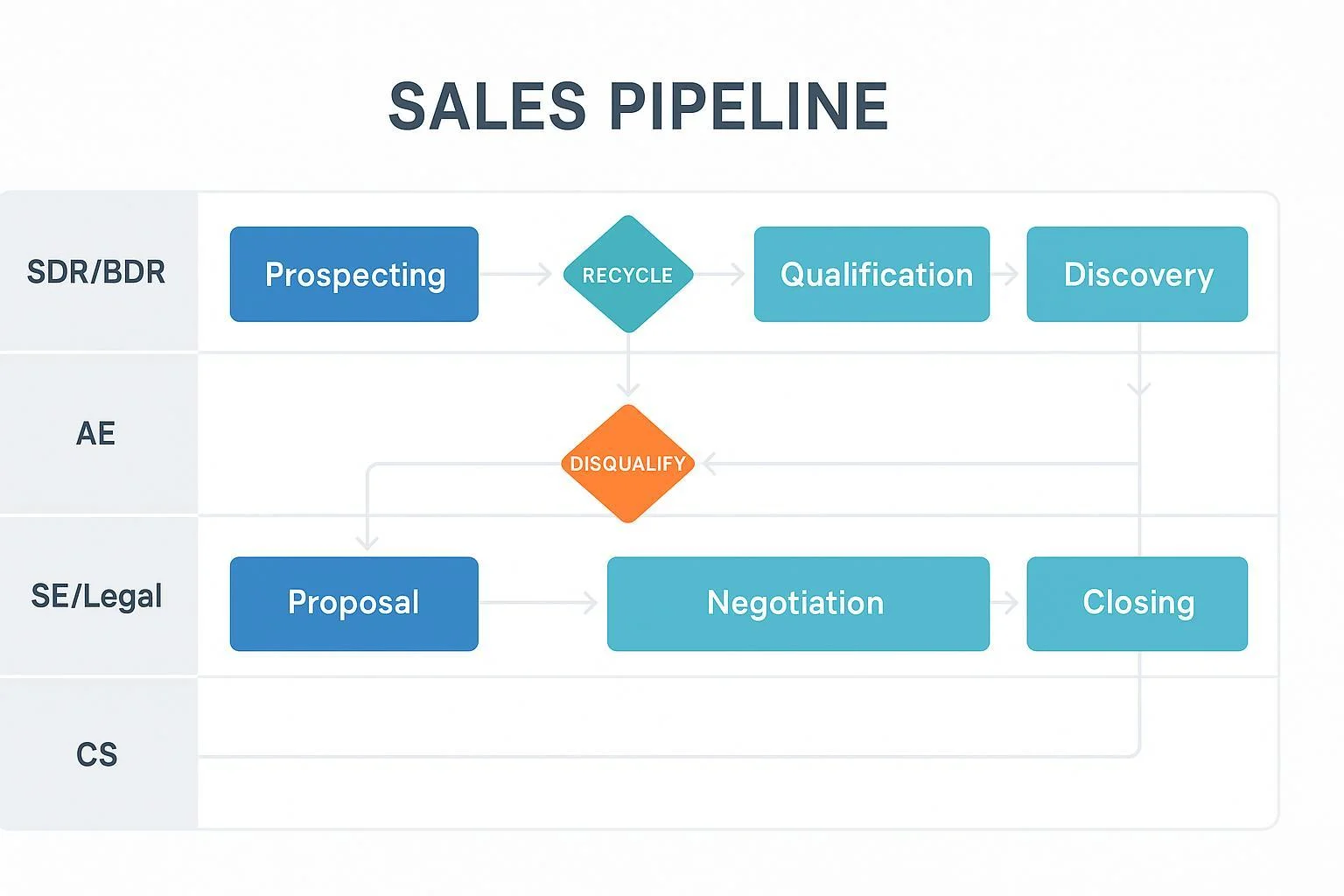
Your pipeline flowchart should be a single source of truth that aligns sales, marketing, RevOps, and customer success on exactly how opportunities progress—from first touch to onboarding. Use this checklist to build or audit a clear, stage-based flow that your CRM, coaching, and forecasting can all rely on.
Note: Stage patterns and governance here reflect widely adopted 7–8 step models. For context and definitions, see the 2025 overview in Salesforce’s sales pipeline management and HubSpot’s 2025 sales pipeline guide.
1) Foundations: Set your rules before you draw
Define your Ideal Customer Profile (ICP) and disqualifiers.
- Why this matters: Clear ICPs prevent unqualified deals from clogging early stages.
Establish stage names and short, objective definitions (Prospecting, Qualification, Discovery, Proposal, Negotiation/Review, Closing, Post‑sale/Onboarding).
- Why this matters: Consistent names and criteria reduce ambiguity and improve reporting integrity.
Assign ownership by swimlane (BDR/SDR, AE, SE/Legal/Finance, CS/Onboarding).
- Why this matters: Swimlanes clarify handoffs in the flowchart and in real life.
Document entry and exit criteria for every stage (what must be true to enter/advance).
- Why this matters: Objective criteria reduce sandbagging and protect forecast accuracy.
Map stages to forecast categories before rollout (e.g., Pipeline, Best Case, Commit, Closed) and align probabilities.
- For configuration principles, see the Salesforce Forecasts Guide (updated through 2025): Salesforce forecasts guide (PDF). Ensure your stage→category mapping is explicit and documented.
Standardize required fields and picklists by stage (e.g., Primary Contact, Next Step, Close Date, Amount, Stakeholder Roles, Risks, Procurement Path).
- Enforce with validation rules; Salesforce’s reference of common formulas (2025) is a useful model: Useful validation formulas.
Define SLAs for handoffs and speed-to-lead (e.g., marketing → SDR within 24 hours; SDR first-touch within hours for high‑intent inbound).
- HubSpot’s 2025 materials emphasize quick response for inbound; see the HubSpot sales statistics page for speed‑to‑lead insights and targets.
Choose visualization standards: left‑to‑right flow, decision diamonds for yes/no, labeled branches for Recycle and Disqualify, swimlanes by role, and a version/date stamp.
- Lucid’s 2024–2025 instructions explain flowchart conventions and symbols: Flowcharts: A guide from start to finish.
2) Stage-by-stage checklist (build or audit)
For each stage, verify ownership, entry/exit criteria, required CRM fields, artifacts, and alerts.
Prospecting (Owner: BDR/SDR)
- Confirm account/lead matches ICP and has a captured Lead Source.
- Require at least one qualified engagement (e.g., reply, call connect, form with intent).
- Enforce a “Next Step” date/action for every active record.
- Set a timebox alert (e.g., 7–14 days) to prevent stalling.
- Exit only when a meeting is scheduled or a positive qualification signal exists; otherwise branch to Recycle or Disqualify.
- Common pitfall: Advancing without any stakeholder identified.
Qualification (Owner: BDR/SDR or AE depending on motion)
- Document Pain, Fit, and Access: problem statement, ICP fit signals, and path to stakeholders (frameworks like MEDDIC/SPICED can inform criteria).
- Identify at least one stakeholder by role; capture company context and basic timing.
- Create an Opportunity only when fit and intent are evidenced.
- Set stage duration thresholds and alerts (e.g., auto-flag after 10 days without a meeting).
- Exit only when the AE has a scheduled Discovery and a named buyer contact; otherwise Recycle (e.g., wrong timing) or Disqualify (e.g., non‑fit).
- Why this matters: Clear gates avoid inflating early‑stage pipeline with low‑probability deals.
Discovery / Needs Analysis (Owner: AE)
- Capture problem, impact, decision process, and decision criteria in fields/notes.
- Identify Champion and Economic Buyer roles (names if possible); start a stakeholder map.
- Log risks/blockers and the “paper process” (legal, security, procurement) if enterprise.
- Record a mutual action plan (MAP) link or next two scheduled steps.
- Exit only when solution fit is validated with stakeholders and a next meeting is booked.
- Common pitfall: Skipping decision process documentation, causing delays later.
Proposal (Owner: AE; support: SE/Finance)
- Confirm solution requirements and success criteria are agreed in writing.
- Deliver a formal proposal (attach file or link) and record amount, term, and close date.
- Tag all known buying committee members and their roles.
- Identify legal/procurement path; attach any security questionnaires or checklists.
- Exit only when the customer acknowledges receipt and next review/exec touch is scheduled.
- Why this matters: Documented scope reduces rework during negotiation.
Negotiation / Review (Owner: AE; support: Legal/Finance)
- Track commercial concessions and redlines in a single source (doc or field set).
- Confirm executive sponsor touch and Champion alignment on approval path.
- Attach the latest proposal/Order Form and version notes.
- Keep “Next Step” current; set alerts for inactivity (e.g., >7 days without activity).
- Exit only when terms are aligned and signatories are identified; move to Closing.
- Common pitfall: Moving to Commit forecast without executive validation.
Closing (Owner: AE)
- Verify all approvals are complete and signatories confirmed.
- Ensure Opportunity fields are clean: Amount, Close Date, Forecast Category, Primary Contact, and Products/Services.
- Record Closed Won/Lost with reason codes and notes.
- Trigger AE → CS handoff package automatically on Closed Won.
- Governance note: Keep stage→forecast category mapping documented and audited monthly; see Salesforce’s Collaborative Forecasting guidance (2025): Collaborative Forecasting best practices.
Post‑sale / Onboarding (Owner: CS/Onboarding)
- Deliver a structured handoff from Sales: goals, use cases, stakeholders, technical needs, risks, promised outcomes, and contract essentials.
- Schedule kickoff within a defined SLA (e.g., 72 hours of Closed Won) and confirm success plan with milestones.
- Set early adoption checkpoints (e.g., first value, usage thresholds, cadence for health reviews).
- Log expansion signals and renewal date on record creation.
- Gainsight’s 2024–2025 guidance on lifecycle stages and early‑journey structure is a good reference: Define key stages in the customer lifecycle.
3) Recycle and Disqualify: Make the branches explicit
Define Disqualify rules: no-fit ICP, non‑compliant requirements, no authority access with no path, or out‑of‑segment cases.
- Keep Disqualified reason codes standardized for analytics.
Define Recycle/Nurture rules: potential fit later, competing priorities, paused evaluation, budget next cycle.
- Route to nurture programs or SDR cadences with a follow‑up date.
Represent these as decision diamonds off Qualification/Discovery in the flowchart, with clear labels and return paths to Prospecting when re‑engaged.
Require “Next Step” when recycling and an owner for follow‑up.
4) Forecast integrity and reporting
Document stage→forecast category mapping and review monthly with sales leadership.
- As a reference point, Salesforce’s official forecast categories (Pipeline, Best Case, Commit, Closed) and mapping to stages are described in the 2025 forecasts guide. Customize to your motion.
Define when a deal can enter Commit (e.g., executive sponsor validated, MAP milestones on track, legal path confirmed).
Track and publish core metrics:
- Stage Conversion Rates, Win Rate, Sales Cycle Length, and Pipeline Velocity.
- Use Pipeline Velocity as: (Number of Opps × Avg Deal Size × Win Rate) / Sales Cycle Length (days). It’s a widely used RevOps formula to gauge throughput.
Institute a weekly pipeline inspection cadence with risk flags (e.g., no next meeting, no activity X days, missing Primary Contact).
- For a practical overview of inspection patterns, see Outreach’s 2024 guidance: Pipeline inspection guide.
5) Data hygiene and controls (make good data the default)
Enforce required fields by stage using validation rules (e.g., require Primary Contact before Negotiation; require Next Step at or beyond Qualification; prevent Closed Won/Lost edits without admin override).
- Salesforce’s 2025 validation formulas reference offers examples you can adapt: Useful validation formulas.
Set stage duration alerts and dashboards to surface stalls.
Standardize picklists for Lead Source, Industry, Employee Band, Forecast Category, and Reason Codes.
Audit data monthly: random deal samples per stage, comparing entered fields vs. your stage gate checklist.
Attach artifacts to records (proposal PDFs, redline trackers, stakeholder maps, MAPs) to keep context centralized.
6) Visualization best practices for your flowchart
Keep the flow left‑to‑right (or top‑down) with minimal line crossings; label each decision branch.
Use swimlanes for BDR/SDR, AE, SE/Legal/Finance, and CS to make ownership and handoffs obvious.
Place decision diamonds at key gates: “Meets qualification criteria?”, “Solution fit validated?”, “Executive sign‑off confirmed?”, “Ready for onboarding?”
Annotate each stage with concise entry/exit criteria and 1–2 required artifacts.
Include a version number, author, and last review date on the diagram for governance.
If you want symbol guidance and layout patterns, see Lucid’s step‑by‑step 2024–2025 manual: Flowcharts: A guide from start to finish.
7) Quick‑audit: 15 high‑impact checks (printable)
Use this list for weekly manager reviews or quarterly audits.
- Stages have single‑sentence definitions and objective entry/exit criteria.
- Each stage maps to a forecast category with documented rules for Commit.
- Required fields by stage are enforced (Primary Contact, Next Step, Close Date, Amount, Stakeholder Roles).
- Prospecting and Qualification include explicit Recycle and Disqualify branches.
- Every open deal has a future dated “Next Step.”
- Discovery notes include decision process, criteria, and stakeholders.
- Proposal includes attached file/link and defined legal/procurement path.
- Negotiation records track concessions and redlines in one place.
- Stage duration dashboards flag stalls and trigger alerts.
- Primary Contact is present for all late‑stage deals; stakeholder map shows multi‑threading.
- Stage advancement occurs only when exit criteria are met (spot check 10 deals).
- Forecast roll‑ups reconcile with stage counts; anomalies investigated weekly.
- Closed Won triggers a complete AE → CS handoff package within SLA.
- Onboarding success plans exist with first‑value milestones.
- Inspection cadence is on calendar; risks (no next meeting, no exec contact) are visible in reports.
8) Example stage gate criteria you can adopt today
- Advance to Discovery only if Pain, Impact, and Decision Criteria are documented in CRM notes/fields.
- Advance to Proposal only if Champion and Economic Buyer are identified and next exec touch is scheduled.
- Advance to Negotiation only if legal/procurement steps are identified and proposal is acknowledged by the buyer.
- Move to Commit forecast only if executive sponsor validation is recorded and MAP milestones are on track.
- Trigger CS handoff only when contract assets and a summary of goals/use cases are attached.
9) Governance cadence (keep it healthy over time)
Monthly: Audit 10 random opportunities per stage against the checklist; update validation rules as needed.
Quarterly: Review stage definitions, forecast mapping, and SLA performance with leadership; adjust thresholds (duration, conversion) based on current cycle times.
Semi‑annually: Refresh the flowchart version and re‑train teams; archive the prior version with change notes.
Weekly: Run pipeline inspection with standardized risk flags; Outreach’s 2024 overview is a helpful pattern reference: Pipeline inspection guide.
References and further reading
- Salesforce (2025) overview of pipeline patterns: Sales pipeline management
- HubSpot (2025) fundamentals and definitions: Sales pipeline guide
- Salesforce (2025) forecast categories and mapping: Forecasts guide PDF
- Salesforce (2025) data validation examples: Useful validation formulas PDF
- Lucid (2024–2025) diagramming conventions: Flowcharts: A guide from start to finish
- Gainsight (2024–2025) lifecycle and onboarding checkpoints: Define key stages in the customer lifecycle
- Outreach (2024) inspection cadence pattern: Pipeline inspection guide