
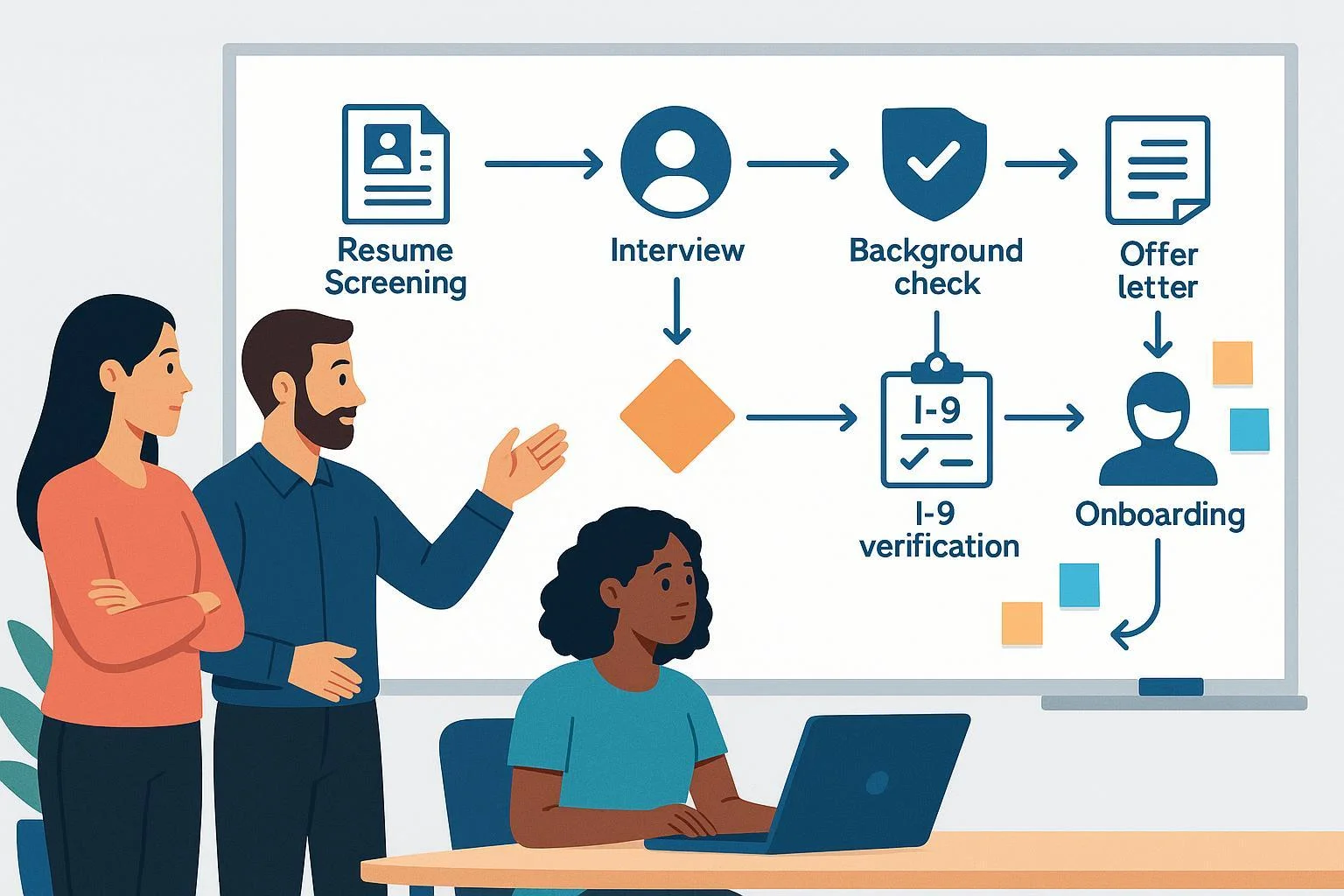
Use this practical, compliance-aware template to standardize hiring at a small or midsize business in the United States. It’s designed for owners, first-time hiring managers, and HR generalists who need a clear, repeatable process.
Note: This guide is for general information only and is not legal advice. Always confirm state and local requirements with qualified counsel.
How to use this template
- Follow the stages in order. Each item starts with an action verb and ends with a clear completion test.
- “Compliance checkpoint” flags legal/regulated steps. “Common pitfall” warns of frequent mistakes.
- Ownership hints: HM = Hiring Manager; HR = HR/People Ops; FIN = Finance/Payroll; IT = IT/Facilities.
Flowchart legend (minimal)
- Round start/end: Begin/Finish
- Rectangle: Action
- Diamond: Decision gate
- Arrow: Next step
- Red label: Compliance checkpoint
Quick-start map (text view with decision points)
- Start → Plan & Approvals → Source & Advertise → Screen → Assess & Interview → Select + References/Background → Offer → Pre-employment & Verification → Day-1 → Post-hire review → End
- Decision gates: Meets minimum qualifications? Passed phone screen? Passed assessment? Reference/background clear? Offer accepted? Work authorization verified?
1) Plan & Approvals
Define the business need and role scope (HM)
- Completion: Problem statement, top 3 outcomes, and staffing type decided (employee vs contractor). If employee, define FLSA status and exempt/nonexempt rationale.
- Common pitfall: Skipping FLSA classification can create wage/overtime risk.
Draft an inclusive, job-related description (HM + HR)
- Completion: Final JD includes essential functions, skills, physical/attendance requirements, and reasonable accommodation language.
- Compliance checkpoint: Avoid criteria that screen out protected groups unless job-related and necessary; apply criteria consistently under EEOC principles. See the EEOC’s guidance on using background and other screens fairly in the hiring process in the 2025 timeframe in the overview at EEOC background checks.
Determine pay range and posting disclosures (HM + HR + FIN)
- Completion: Pay range approved; posting text reflects required disclosures in any applicable jurisdictions with pay transparency rules.
- Common pitfall: Asking for salary history where prohibited in many jurisdictions.
Approve budget and timeline (HM + FIN)
- Completion: Requisition created; target start date; interview panel defined.
2) Source & Advertise
Choose channels and post the role (HR)
- Completion: Job posted to selected boards, company site, and relevant communities; include a concise EEO statement.
Set up a structured application intake (HR)
- Completion: Application form collects only job-related data; privacy notice indicates how applicant data is stored and for how long.
Establish standardized screening criteria (HM + HR)
- Completion: Minimum qualifications and nice-to-haves documented before reviewing applicants; criteria shared with everyone reviewing.
3) Screen
Triage applications against minimums (HR)
- Decision gate: Meets minimum qualifications?
- Yes → Phone screen
- No → Disposition respectfully; retain records per your policy and EEOC recordkeeping rules.
- Decision gate: Meets minimum qualifications?
Conduct a consistent phone screen (HM or HR)
- Completion: 15–20 minute call using a short script; notes captured in ATS or tracker; candidates informed about next steps and accommodation process.
Prepare accommodations as needed (HR)
- Completion: Contact provided for accommodation requests; interview logistics are accessible.
- Compliance checkpoint: Do not ask disability-related questions pre-offer; focus on ability to perform essential functions. See EEOC’s guidance on pre-offer medical questions and exams in EEOC medical inquiries and examinations.
4) Assess & Interview (Structured)
Select validated assessments as needed (HM + HR)
- Completion: Any test is demonstrably job-related and administered uniformly; cut scores decided in advance.
Run structured interviews (HM leads; HR supports)
- Completion: Standard question set mapped to competencies; anchored rating scales; interviewers trained; scores documented.
- Why it matters: Structured interviews improve fairness and reliability. See the U.S. Office of Personnel Management’s guidance on structured interviews in OPM structured interviews.
Decision gate: Candidate passes assessment/interviews?
- Yes → Move to selection
- No → Disposition; consider next candidate.
5) Select & References/Background
Conduct reference checks (HM or HR)
- Completion: 2–3 recent managers/peers; job-related questions only; notes stored with candidate file.
If using background checks via a Consumer Reporting Agency (CRA), follow FCRA steps (HR)
- Completion: Standalone disclosure provided; written authorization obtained before the check; if considering adverse action, send pre-adverse notice with report and Summary of Rights; after decision, send adverse action notice with required statements.
- Compliance checkpoint: Follow the Fair Credit Reporting Act sequence and timing, as summarized by the U.S. Federal Trade Commission in FTC employer background checks and your rights.
Apply EEOC-recommended practices for criminal history (HR + HM)
- Completion: No blanket exclusions; consider nature of offense, time elapsed, job relevance; allow individualized assessment when appropriate.
- Compliance checkpoint: Ensure selection practices don’t cause unlawful disparate impact; see the EEOC’s 2025-era overview on fair screening practices in EEOC background checks.
Decision gate: References/background clear enough to proceed?
- Yes → Draft offer
- No → Conduct individualized assessment; consult counsel as needed; move to alternate candidate if decision stands.
6) Offer
Prepare a written offer letter (HR + HM + FIN)
- Completion: Title, pay, classification (exempt/nonexempt), work location/schedule, manager, start date, at-will statement (if applicable), contingencies (background, work authorization), and any bonus/equity terms.
Communicate benefits highlights and deadlines (HR)
- Completion: Summary of eligibility and enrollment windows; key policies attached or linked.
Decision gate: Offer accepted?
- Yes → Pre-employment & verification
- No → Debrief, consider counter-offer, or move to next finalist; if search is exhausted, loop back to Source & Advertise.
7) Pre-employment & Verification
Complete Form I-9 on time (HR or designated I-9 Admin)
- Completion: Employee finishes Section 1 by day 1; employer completes Section 2 by end of the third business day after the start date; documents examined appropriately.
- Compliance checkpoint: Follow current U.S. Citizenship and Immigration Services guidance on timing, acceptable documents, anti-discrimination rules, and retention in USCIS Form I‑9 Central. USCIS notes that each Form I‑9 must be retained for 3 years after hire or 1 year after termination, whichever is later.
If eligible and enrolled, consider the DHS-authorized remote I‑9 alternative (HR)
- Completion: If you use the optional remote alternative, confirm E‑Verify good standing, use live video interaction, retain copies, and annotate the form appropriately.
- Compliance checkpoint: See the Department of Homeland Security’s 2023 rule in the Federal Register, 88 FR 47982 on optional Alternative 1.
Run E‑Verify if required by your status/jurisdiction (HR)
- Completion: If you participate, open the case by the end of day 3 after the start date and follow TNC procedures.
Set up payroll and taxes (HR/FIN)
- Completion: W‑4 collected; state withholding form if applicable; direct deposit; add to payroll and benefits systems.
Report the new hire to the state directory (HR/FIN)
- Completion: New-hire report submitted within the state’s deadline (often within 20 days; some states shorter); multistate employers follow consolidated reporting if elected.
- Compliance checkpoint: See federal requirements from the U.S. Office of Child Support Services in HHS/OCSE new‑hire reporting.
Provide required notices and policy acknowledgments (HR)
- Completion: Handbook receipt; anti-harassment; IT/security; confidentiality/IP; safety; any state/municipal notices.
8) Day‑1 Readiness
Provision equipment and access (IT + HR)
- Completion: Laptop/phone/badges; accounts for email, HRIS, payroll, core apps; permissions set.
Launch orientation and training plan (HR + HM)
- Completion: Day‑1 schedule; 30/60/90‑day goals; required compliance/safety trainings.
Assign a buddy/mentor and first-week check-ins (HM)
- Completion: Meetings on calendar; success metrics clear.
9) Post‑hire Review & Record Retention
Schedule early performance check‑ins (HM)
- Completion: 2-, 4-, and 8-week touchpoints; feedback recorded.
Monitor process quality and fairness (HR)
- Completion: Review pass‑through rates by stage when feasible; adjust criteria to reduce bias while maintaining job relevance.
Retain recruiting and I‑9 records per policy and federal guidance (HR)
- Completion: Recruiting records are retained per EEOC recordkeeping rules; Form I‑9s kept for the required period and stored for authorized inspection per USCIS guidance cited above.
Conduct a post‑mortem on the requisition (HM + HR)
- Completion: What worked, what slowed you down, and what to improve captured in your SOP.
One‑page, copy‑paste flow (ASCII)
Start
  ↓
[Plan & Approvals]
  • Define need → Draft JD → Approve pay/timeline
  ↓
[Source & Advertise]
  • Post → Intake ready → Screening criteria set
  ↓
[Screen]
  ◇ Meets minimums?
     ├─ No → Disposition → End (retain records)
     └─ Yes → Phone screen → Accommodations as needed
  ↓
[Assess & Interview]
  • Structured interviews/assessments
  ◇ Pass?
     ├─ No → Disposition → End (retain records)
     └─ Yes → Selection shortlist
  ↓
[References/Background]
  • References → FCRA steps if CRA used → EEOC‑aligned review
  ◇ Clear to proceed?
     ├─ No → Individualized assessment → If final No → Next candidate
     └─ Yes → Offer
  ↓
[Offer]
  ◇ Accepted?
     ├─ No → Next candidate or loop back to Sourcing
     └─ Yes → Pre‑employment
  ↓
[Pre‑employment & Verification]
  • I‑9 (S1 Day 1; S2 by Day 3) → Optional DHS remote path if eligible → E‑Verify (if used)
  • Payroll/benefits setup → State new‑hire reporting → Required notices
  ↓
[Day‑1]
  • Equipment/access → Orientation/training → 30/60/90 plan
  ↓
[Post‑hire]
  • Check‑ins → Record retention → Process improvements
End
Adapt this template for common SMB scenarios
Remote/multi‑state hiring
- Confirm state registration, tax withholding, paid leave, and posting disclosures for the employee’s work location. Use the DHS remote I‑9 alternative only if you meet eligibility and follow required steps per 88 FR 47982.
High‑volume hourly hiring
- Batch phone screens with a standardized script; shorten cycles by pre‑booking interview blocks; maintain structured ratings to preserve fairness. Use job‑related, validated assessments; when in doubt, review against principles embedded in the EEOC’s selection guidance and the structured interview methods from OPM structured interviews.
Sensitive or regulated roles
- If you require extensive screening, ensure tests and checks are demonstrably job‑related and consistent with business necessity; follow FCRA steps if using a CRA via the FTC employer background checks summary; apply individualized assessments aligned with the spirit of EEOC background checks.
Compliance checkpoints at a glance
- Pre‑offer medical/disability inquiries prohibited; focus on essential functions and job requirements, per the ADA guidance in EEOC medical inquiries and examinations.
- Use structured, job‑related selection tools; document criteria and outcomes. See OPM structured interviews.
- If using a CRA for background checks, follow the FCRA sequence (disclosure, authorization, pre‑adverse/adverse). Refer to FTC employer background checks and your rights.
- Complete Form I‑9 on time; retain I‑9s per USCIS rules; consider DHS’s optional remote alternative only if eligible. See USCIS Form I‑9 Central and 88 FR 47982.
- Report new hires to the state directory within required timelines; see HHS/OCSE new‑hire reporting.
Common pitfalls (and fixes)
- Vague criteria or ad‑hoc interviews → Fix: Define minimums upfront; use structured interviews and anchored scores.
- Asking prohibited questions → Fix: Train interviewers on lawful topics; follow ADA rules noted in the EEOC medical inquiries guidance.
- Skipping FCRA steps → Fix: Use standalone disclosure/consent and pre‑adverse/adverse action notices if using a CRA.
- Late or incorrect I‑9s → Fix: Track Day‑1/Day‑3 deadlines; follow current USCIS instructions or eligible DHS remote procedure.
- Missing state new‑hire reporting → Fix: Calendar deadlines and assign responsibility to HR/FIN.
Keep this template in your SOP, print the ASCII flow for your wall, and meet monthly to refine stages, criteria, and timing. With clear decision gates and compliance checkpoints, your SMB can hire faster, fairer, and with fewer risks.