
Introduction
In the search engine ecosystem, whether a page is properly indexed by Google determines whether it is even eligible to appear in search results. No matter how high-quality your content is—whether it’s a blog post, product page, or technical documentation—if Google cannot crawl, render, or index it, organic visibility is effectively blocked.
This guide provides a comprehensive explanation of Google SEO indexing principles and practical techniques. It is designed to help website owners, content creators, and developers understand how Google discovers pages, processes content, and ultimately makes indexing decisions. The article covers indexing fundamentals, crawling and rendering mechanisms, on-page optimization strategies, structured data usage, and common indexing issue diagnostics, offering a clear and actionable framework for improving long-term search visibility.
Understanding Google SEO Indexing
Google SEO Indexing Overview
In Google Search, indexing refers to the process of storing crawled and processed web pages in Google’s searchable index. Only pages that are successfully indexed can appear in search results.
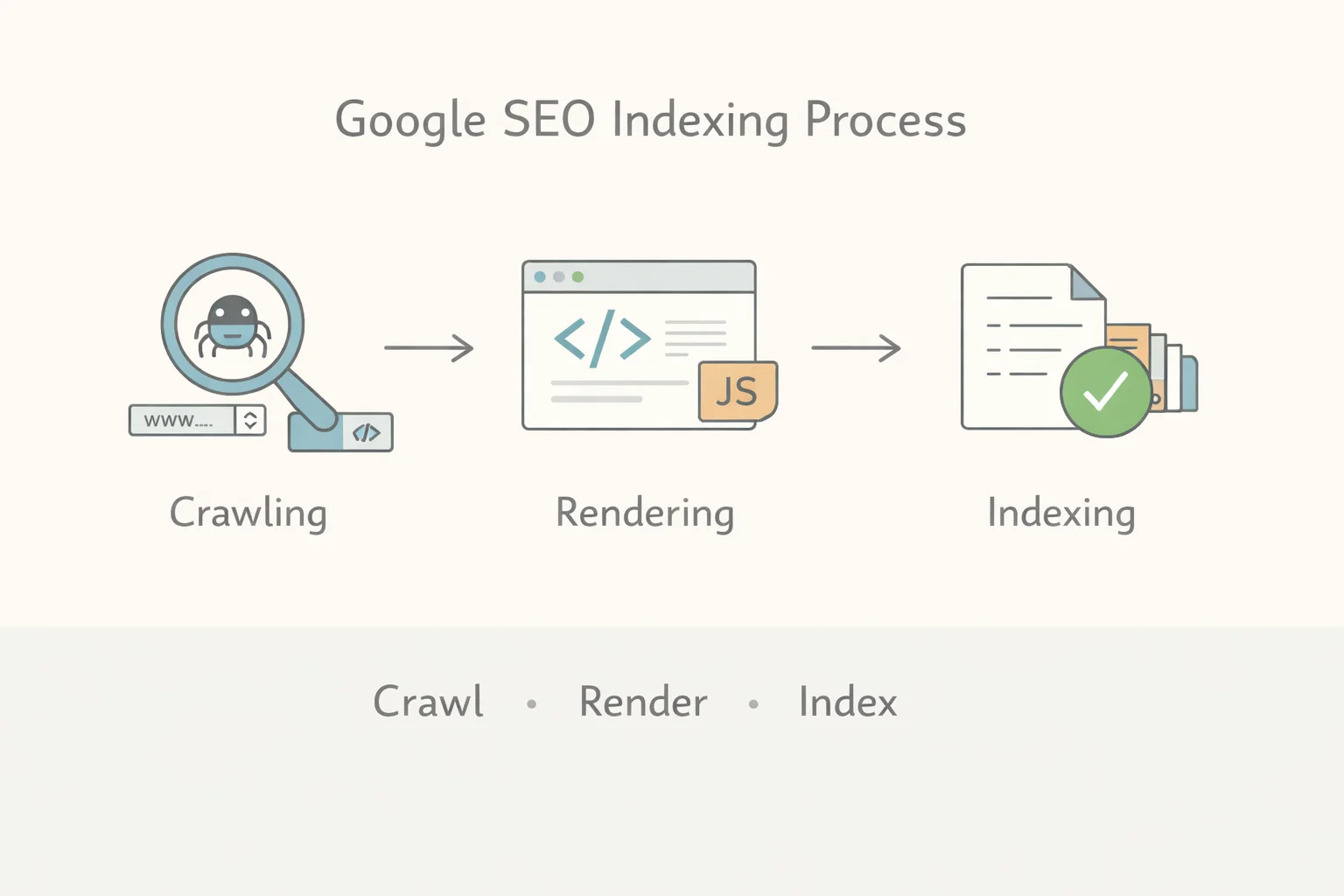
According to Google’s official documentation in the Google Crawling and Indexing Overview, pages generally go through three core stages:
Crawling → Rendering → Indexing
- Crawling: Googlebot discovers and fetches URLs
- Rendering: Google processes HTML, CSS, and JavaScript to understand the final page content
- Indexing: Google evaluates quality, structure, and signals to decide whether the page should be stored in the index
Understanding this workflow is essential, as it forms the foundation of all SEO indexing optimization efforts.
Why Proper Indexing Matters
Indexing status directly determines whether a page has any opportunity to generate organic traffic. Even if a page perfectly matches user intent, it will not appear in search results unless it is indexed.
Typical differences between indexed and non-indexed pages:
| Page Status | Eligible for Ranking | Organic Traffic Potential | Real Impact |
|---|---|---|---|
| Indexed | Yes | Possible | Content can gain visibility |
| Not indexed | No | Nearly zero | Content value is wasted |
Websites with unstable index coverage often experience delayed traffic for new content or poor visibility for key pages, which ultimately undermines overall SEO performance.
How Google Crawls and Renders Your Website
Crawling Best Practices
Google’s crawling process is handled by Googlebot. Its role and behavior are well documented in Googlebot (Crawler) Wikipedia. Understanding how crawling works helps site owners make better technical and structural decisions.
Robots.txt configuration
The robots.txt file controls crawler access to site paths. Google’s Google robots.txt Guide emphasizes that robots.txt affects crawling—not indexing directly. A common mistake is blocking CSS or JavaScript resources, which can prevent Google from properly rendering pages.
Sitemap submission and maintenance
Sitemaps improve URL discovery efficiency but do not guarantee indexing. Google explains in the Build and Submit a Sitemap Guide that sitemaps are especially useful for large sites, deep architectures, or frequently updated content.
Common crawling issues and diagnostics
| Crawling Issue | Possible Cause | Diagnostic Direction |
|---|---|---|
| Page not discovered | Weak internal linking | Improve site structure |
| Crawl failed | Server errors | Check HTTP status codes |
| Low crawl efficiency | Crawl budget waste | Remove low-value URLs |
Rendering Insights
Modern websites increasingly rely on JavaScript to render content dynamically. While Google can execute JavaScript, rendering is not always immediate and may occur after the initial crawl.
Key rendering considerations include:
- Whether critical content is present in the initial HTML
- Whether content loads only after user interaction
- Whether mobile and desktop render results are consistent
Common rendering-related indexing failures include:
- Core text injected asynchronously
- Content appearing only after client-side execution
- Blocked resources due to robots.txt rules
Practical Techniques for SEO Indexing
On-Page Optimization for Indexing
On-page optimization provides the baseline signals Google needs to understand a page’s topic and relevance.
Title tags and meta descriptions
Clear, descriptive titles help search engines interpret page intent and influence click-through behavior in search results.
URL structure
Short, readable URLs are easier to crawl, manage, and maintain than parameter-heavy or opaque paths.
Natural keyword placement
Keywords should appear naturally in titles, introductions, and body content to reinforce semantic relevance—without stuffing.
| Optimization Area | Before | After |
|---|---|---|
| Title clarity | Vague | Topical and descriptive |
| URL format | Parameter-heavy | Clean and readable |
| Content structure | Disorganized | Logically structured |
Using Structured Data to Boost Visibility
Structured data uses Schema markup to help search engines better understand page content and potentially generate enhanced SERP displays. Background context on structured formats can be found in the Sitemaps Protocol Overview.
SERP display comparison:
| Result Type | Without Structured Data | With Structured Data |
|---|---|---|
| Presentation | Basic snippet | Rich results |
| Information density | Low | High |
| Click appeal | Average | Stronger |
Structured data does not directly improve rankings. Pages must first be indexable, and all markup must accurately reflect visible page content. For hands-on implementation, practical examples in ShortKey’s free tutorials can help clarify the full workflow from markup to validation. Check ShortKey’s SEO Indexing Guide for a complete step-by-step guide suitable for all stages of learning.
Troubleshooting Common Indexing Issues
Indexing problems are usually caused by a combination of technical constraints and content signals rather than a single factor.
Common issues include:
- Pages not indexed
- 404 or soft 404 errors
- Redirect loops
- AMP indexing failures
Typical diagnostic questions:
Why is a page discovered but not indexed?
This often relates to thin content, duplication, or incomplete rendering.
Do redirects affect indexing?
Proper 301 redirects generally do not, but chained or circular redirects reduce crawl efficiency.
Why are AMP pages not indexed?
Check canonical relationships, validation status, and content consistency between AMP and canonical pages.
Learning Resources for Beginners
SEO Learning Path from Zero
For beginners, understanding how indexing works is more important than mastering tools. Google’s official Google SEO Starter Guide provides a solid foundation covering core principles and best practices.
Suggested learning stages:
| Stage | Focus | Practical Goal |
|---|---|---|
| Beginner | Crawling and indexing basics | Ensure discoverability |
| Intermediate | Page and structure optimization | Stable index coverage |
| Advanced | Crawl budget and signals | Overall efficiency |
Frequently Asked Questions (FAQ)
Why isn’t my page indexed by Google?
Common causes include low content quality, technical blocks, or high duplication.
Does structured data really improve click-through rates?
In suitable contexts, rich results often increase visibility and user engagement.
What if my sitemap submission doesn’t work?
Check sitemap format, URL accessibility, and reports in Google Search Console.
How do I diagnose AMP pages that aren’t indexed?
Review canonical setup, validation errors, and content parity.
Conclusion and Key Takeaways
The core goal of Google SEO indexing optimization is to ensure that search engines can discover, understand, and trust your content. By implementing proper crawling configurations, maintaining clear page structures, sending consistent technical signals, and using systematic diagnostic methods, websites can achieve stable index coverage and long-term search visibility.
For those looking to deepen their practical understanding, ShortKey’s free SEO tutorials provide step-by-step guidance from crawling fundamentals to advanced indexing workflows, helping turn theory into sustainable search performance.