Miro has become a household name for visual collaboration, powering brainstorming sessions, project planning, and workshops for over 30 million users worldwide. Its rise to a $17.5 billion valuation underscores its market dominance. However, its pricing structure can be a barrier for individuals, students, freelancers, and small teams who need robust whiteboarding capabilities without the recurring cost. The good news is that the competitive landscape has evolved, with several powerful platforms now offering compelling free tiers.
This guide provides an objective, detailed comparison of the best free Miro alternatives available today. We will move beyond simple feature lists to help you understand the trade‑offs, identify the right tool for your specific scenario, and navigate the common limitations of free plans. Whether you're mapping ideas solo, collaborating on a student project, or facilitating a light workshop, you can find a capable tool that fits your needs and budget.
What to Look for in a Free Collaborative Whiteboard
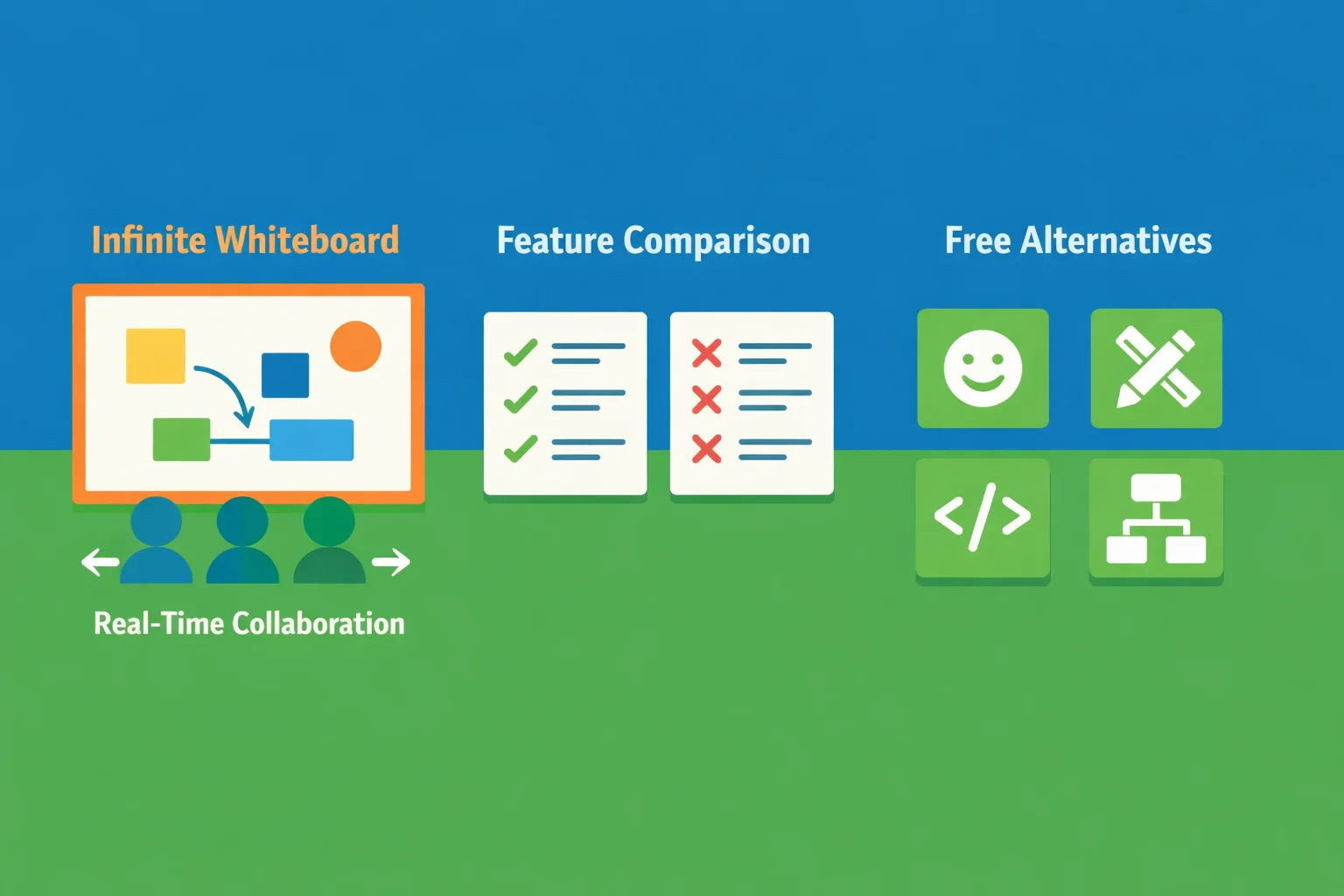
Before diving into specific tools, it's crucial to set realistic expectations. Free plans are typically designed as entry points or for light use, and understanding their common constraints will help you make an informed choice. According to industry analyses like the Gartner Market Guide for Visual Collaboration Tools, core capabilities of these platforms include an infinite canvas, shape libraries, and real‑time co‑editing.
When evaluating a free alternative, consider these essential features and typical limitations:
Core Features to Expect (The Miro‑Like Basics):
- Infinite Canvas: The ability to zoom and pan across a vast, unbounded workspace.
- Sticky Notes & Text Tools: For capturing and organizing ideas, votes, and comments.
- Drawing & Diagramming Tools: Freehand pens, arrows, connectors, and basic shape libraries.
- Real‑Time Collaboration: Multiple users seeing cursors and edits live on the same board.
Common Free Plan Restrictions:
- Board/Diagram Limits: A cap on the number of active files or projects you can maintain — for example, ProcessOn’s free tier limits the number of personal files and collaborators.
- Participant/Editor Caps: Limits on how many people can edit or be part of a workspace.
- Template Access: A restricted library of pre‑built frameworks for workshops, diagrams, or planning.
- Export & Integration Options: Limited file export formats or lack of integrations with other apps.
- Storage & History: Constraints on total storage space or limited version history for recovering past board states.
Key Evaluation Criteria:
- Collaboration Performance: How smooth is the real‑time experience with multiple editors?
- User Interface & Learning Curve: Is the tool intuitive for all participants, including non‑technical users?
- Data Privacy & Ownership: Who owns the content you create? Where is it stored?
- Best‑For Scenario: Is the tool optimized for quick sketches, formal design thinking workshops, or technical diagramming?
Detailed Comparison of Leading Free Alternatives
Below is a side‑by‑side look at top free alternatives, each with distinct strengths. The following table provides a high‑level overview for quick scanning:
| Tool | Key Free Features | Primary Limitations (Free Plan) | Best For |
|---|---|---|---|
| Figma Jam | Unlimited editable Jam boards; real‑time collab; core sticky notes & shapes. | Only up to 3 editors per file simultaneously. | Designers, product teams, anyone in the Figma ecosystem. |
| Mural | Infinite canvas; sticky notes; structured templates; visitor roles. | Limit of 3 active murals; advanced facilitation locked. | Structured workshops (agile, design thinking). |
| Excalidraw | Completely free; hand‑drawn style; E2E encrypted collaboration. | Minimal templates; fewer business diagram components. | Quick brainstorming, privacy‑focused use. |
| tldraw | Free, open‑source; infinite canvas; real‑time multiplayer; self‑hostable. | Minimal built‑in templates. | Developers, technical teams, minimalists. |
| ProcessOn | Free real‑time collaboration; rich set of diagram types (flowcharts, mind maps, UML, BPMN); whiteboard included. | Limited number of personal files and collaborators on free tier; some advanced export options may require upgrade. | Structured visual workflows and team diagramming. |
Figma Jam
Figma Jam is Figma’s dedicated whiteboarding tool, launched to compete with tools like Miro. Its free Starter plan is generous, offering unlimited editable Jam boards and real‑time collaboration with unlimited viewers. Core features like sticky notes, drawing tools, and shape libraries are fully available. The main constraint is a limit of up to 3 active editors on a single Jam file at once, which makes it perfect for small team sessions but less ideal for large workshops.
Mural
Mural offers a Starter free plan tailored for individuals and small teams. It provides the core whiteboarding basics — an infinite canvas, sticky notes, and a set of templates — alongside structured support for workshop methodologies like agile retrospectives and design thinking frameworks. However, the free plan restricts users to only 3 active murals (boards) and many advanced facilitation and export tools require paid subscriptions.
Excalidraw
Excalidraw takes a minimalist, open‑source approach with a hand‑drawn visual style. It’s completely free and often requires no sign‑up. It supports end‑to‑end encrypted collaborative rooms and stores drawings locally by default. The trade‑off is a lack of extensive templates or advanced organization features that commercial solutions provide.
tldraw
tldraw is another excellent open‑source alternative focused on developer‑friendly extensibility. With a clean infinite canvas and essential drawing tools, it’s ideal for those who want lightweight, customization‑friendly environments. It emphasizes privacy and user control with real‑time rooms and optional self‑hosting but lacks rich business‑oriented templates.
ProcessOn
ProcessOn is a free collaborative whiteboarding and diagramming platform that supports a wide range of visual formats — flowcharts, mind maps, UML diagrams, BPMN, organizational charts, and more — with real‑time editing and a large template library. The free tier includes essential collaboration and diagramming features, but limits the number of personal files and collaborators compared to paid plans, and some export formats are restricted.
ProcessOn stands out for its structured visual workflow capabilities, making it especially useful for teams that need both diagramming and ideation in one place.
Short‑Term Activation Options:
In addition to free and paid subscriptions, officially supported short‑term activation codes exist that grant time‑limited access to premium ProcessOn features (such as advanced diagrams, export formats, and collaboration tools) for defined durations (e.g., 1‑day, 3‑day, 7‑day, 15‑day, 30‑day periods). These official short‑term licenses are ideal for temporary projects or evaluations without long‑term commitment.
Choosing the Right Tool for Your Scenario
The best tool isn’t the one with the most features but the one that fits your specific situation. Here’s how to match common use profiles with the alternatives:
The Solo Student or Freelancer (Mind Mapping & Personal Brainstorming): You need a flexible space for your own ideas, with optional sharing for feedback.
Recommendation: Excalidraw or tldraw for zero barriers; ProcessOn if you also need structured diagram types like flowcharts or mind maps.The Small Startup Team (2–5 people, Lightweight Project Planning): Your team needs a shared board to map out sprint plans, customer journeys, or product roadmaps.
Recommendation: Figma Jam for collaborative sessions; ProcessOn if frequent process diagrams or UML are part of your workflow.The Educator (Interactive Classroom Exercises): You need a simple, reliable tool for classroom activities where students can contribute.
Recommendation: Mural for structured exercises; Microsoft Whiteboard for simplicity; ProcessOn if diagrams are included tasks.Collaborating with External Clients or Guests (One‑off Workshops): You need to bring outside participants into a board for a session.
Recommendation: Mural, Figma Jam, or ProcessOn — all handle visitor roles well, with ProcessOn offering additional diagram formats that can help structure these sessions.
Navigating Free Limits and Temporary Access Options
Even the best free plan might feel restrictive for a specific project. What are your options when you hit a wall?
Strategies for Working Within Free Limits:
- Archive and Reuse: Export boards as PDFs or images and delete older files to stay within file limits.
- External Storage: Store exported boards in cloud drives for long‑term archiving.
- Optimize Board Usage: Use frames or board sections instead of creating many separate boards.
Short‑Term Premium Access:
For time‑bound intensive tasks (like a design sprint or detailed diagram work), officially supported short‑term activation codes for premium features offer temporary access without long‑term billing — a flexible way to get advanced tools when you need them most.
FAQs on Free Miro Alternatives
Can I truly use these for team collaboration for free?
Yes — each supports real‑time collaboration, but free plans often impose limits on the number of editors, boards, or diagrams simultaneously.
Are my boards and data safe on a free plan?
Most reputable tools clarify data ownership and storage practices in their privacy terms. Open‑source tools like Excalidraw and tldraw store data locally or encrypted, while cloud platforms like ProcessOn and Figma Jam sync to the cloud with version history support.
What happens if I need more features later?
Upgrading is sensible if your team’s usage grows. Alternatively, official short‑term premium access can be a cost‑effective way to access advanced features only when needed.
Can I import my existing Miro boards into these tools?
Direct import isn’t broadly supported due to proprietary formats. Export from Miro as PDF/PNG and reassemble in the new platform manually.
In conclusion, the landscape for free Miro alternatives is rich and competitive, driven by a growing market. Whether your priority is unlimited collaborators on a few boards (Figma Jam), structured workshop tools (Mural), limitless private sketching (Excalidraw, tldraw), or temporary access to premium features for a key project, there is a viable free-tier strategy for nearly every need. The key is to align the tool's specific strengths and limitations with your team's size, workflow, and collaboration frequency.