
Introduction
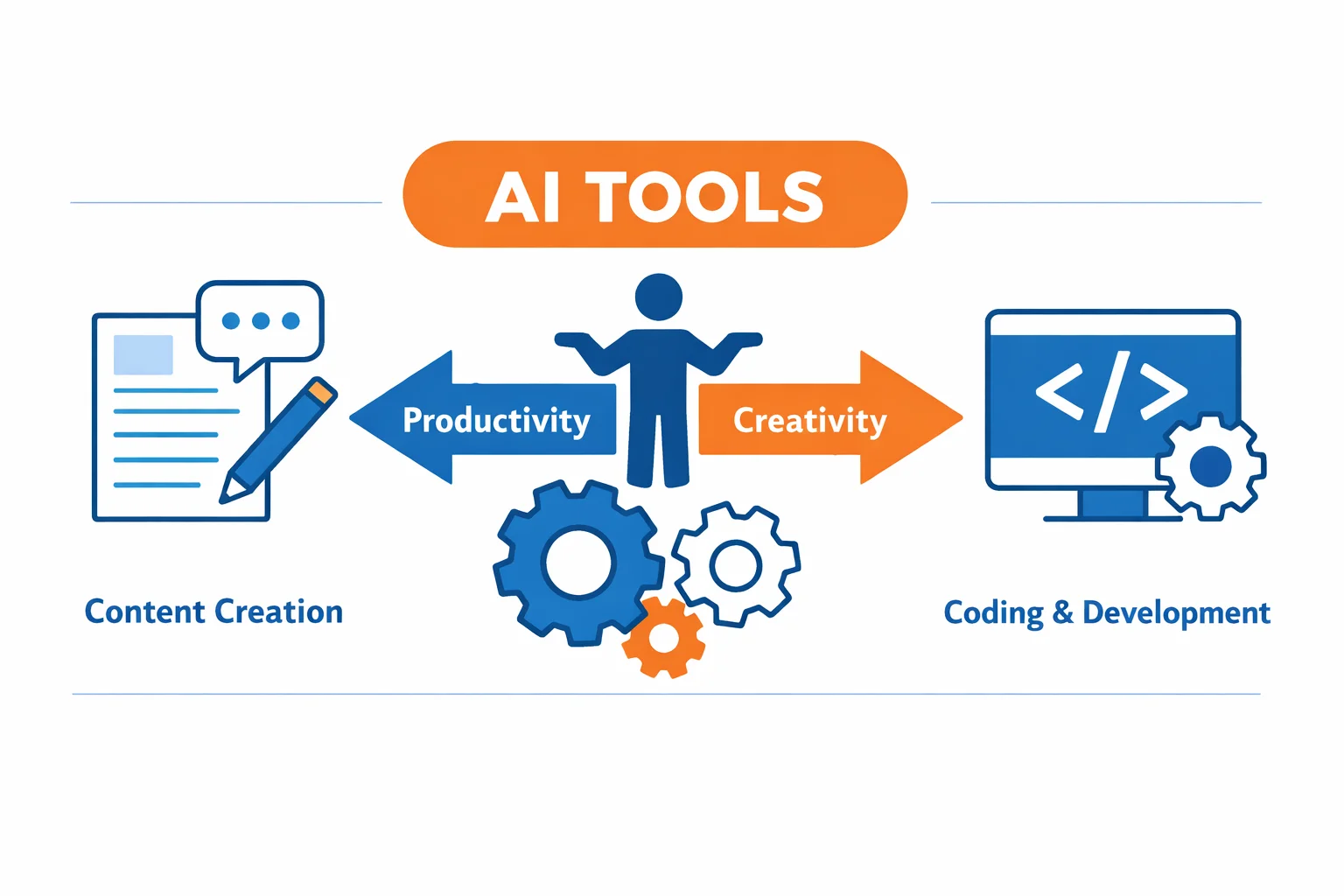
By 2026, AI tools have become deeply embedded in how people write, design, code, plan, and run businesses. What once felt experimental is now operational: content teams rely on AI for ideation and drafting, developers use AI assistants directly inside their IDEs, and business users expect AI to be part of everyday productivity software rather than a standalone novelty.
This guide takes a use-case–first and evidence-based approach. Instead of naming a single “best” AI tool, it compares widely used platforms based on real workflows, feature sets, pricing models, and third-party review data from sources such as G2, Capterra, TrustRadius, and public documentation. The goal is to help you make a more reliable decision—whether you’re creating content, managing operations, or writing code—by understanding what each tool is actually good at, and who it’s best suited for.
Top AI Tools for Content Creation
AI Writing & Text Generation Tools
ChatGPT — General-Purpose AI Writing Assistant
ChatGPT has become a reference point for general AI writing in professional and personal contexts. Its core strengths lie in long-form text generation, rewriting, summarization, ideation, and structured drafting, making it adaptable across many content types.
Typical use cases
- Blog articles and outlines
- Marketing copy drafts
- SEO content assistance and content repurposing
- Creative writing and brainstorming
From a review-platform perspective, ChatGPT is frequently rated highly for Ease of Use and Output Quality, particularly among individual creators and small teams. Pricing flexibility—through a free tier and subscription options—also contributes to strong Value for Money perceptions in G2 and Capterra user feedback.
Because it is not purpose-built for a single industry, ChatGPT works best when users can clearly define prompts and workflows, rather than expecting fully automated publishing or campaign management.
Jasper AI — Marketing-Focused Content Engine
Jasper AI is designed specifically for marketing and brand-driven content production. Unlike general writing assistants, Jasper emphasizes brand voice consistency, campaign templates, and team collaboration features.
Key strengths
- Prebuilt templates for ads, landing pages, and email campaigns
- Brand voice and tone controls
- Team workflows and role-based collaboration
- Integrations with SEO and marketing tools
On platforms like G2, Jasper consistently scores higher than general AI tools in Marketing Use Case and Enterprise Readiness, especially for teams producing content at scale. However, reviews often note that its Pricing Satisfaction depends on usage volume—Jasper is most cost-effective for teams that actively use its collaboration and brand features.
In practice, Jasper and ChatGPT are often compared not as direct replacements, but as tools optimized for different stages of the content lifecycle.
Copy.ai / Writesonic — Short-Form & Marketing Copy Tools
Copy.ai and Writesonic focus on short-form and conversion-oriented content, such as product descriptions, social posts, and ad copy.
- Copy.ai is frequently favored by small businesses for its simplicity and fast output.
- Writesonic appeals to SEO-driven users, offering tools for both short- and long-form content with optimization features.
On G2 and Capterra both platforms show a noticeable difference between Small Business and Mid-Market ratings, reflecting how well they scale with team size. These tools are best suited for users who need speed and volume, rather than deep editorial control.
WPS AI — Document-Centric Writing Assistant
WPS AI integrates AI writing directly into document workflows, focusing on office files like Word, PDF, and presentations. Key features include in-context drafting, summarization, and document formatting assistance, making it ideal for users who work primarily with office documents rather than standalone AI editors.
Best for: Office-centric workflows requiring seamless AI integration
Pricing & access: Subscription-based with flexible access options
Privacy: Supported by clear disclosures in the WPS Office Privacy Policy
Content Creation Tools Comparison
| Tool | Best For | G2 Rating | Capterra Rating | Pricing Model |
|---|---|---|---|---|
| ChatGPT | General writing | ★★★★☆ | ★★★★☆ | Free / Subscription |
| Jasper AI | Marketing teams | ★★★★☆ | ★★★★☆ | Subscription |
| WPS AI | Document-based creation | ★★★★☆ | ★★★☆☆ | Subscription / Flexible access |
Ratings are sourced from publicly available reviews on platforms such as G2 and Capterra and may vary by region and plan.
AI Tools for Business Productivity & Operations
Business-Focused AI Platforms
Gemini (Google AI)
Gemini represents Google’s approach to embedding AI into office automation and productivity workflows. Rather than acting as a separate tool, Gemini extends Google Workspace with AI-assisted writing, summarization, and data analysis.
On TrustRadius and G2, Google Workspace AI features score particularly well in Integration Depth and Enterprise Fit, reflecting how seamlessly Gemini works within an existing Google ecosystem. Its appeal is strongest for organizations already standardized on Google tools.
HubSpot AI
HubSpot AI focuses on CRM, marketing automation, and customer insights. Instead of generic text generation, it supports tasks such as lead scoring, email optimization, and campaign analysis.
When compared with knowledge-centric tools like Notion AI, HubSpot AI ranks higher in G2’s CRM Software category, particularly for SMBs and marketing teams that rely on structured customer data. Its effectiveness depends heavily on how much CRM data a business already has in place.
Notion AI — Knowledge & Planning Assistant
Notion AI is embedded directly into the Notion workspace, supporting writing, summarization, meeting notes, and task planning.
What sets Notion AI apart is its role in cross-functional knowledge management rather than pure content generation. According to the official Notion AI security & privacy practices, customer data is contractually protected from being used to train AI models, which is a key trust factor for teams handling internal documentation.
Business AI Tools Comparison
| Tool | Primary Use | G2 Category Rating | Best For |
|---|---|---|---|
| Gemini | Office AI | ★★★★☆ | Google ecosystem users |
| HubSpot AI | CRM & Marketing | ★★★★☆ | SMB & marketing teams |
| Notion AI | Knowledge & planning | ★★★★☆ | Cross-functional teams |
AI Tools for Visual & Media Content
Image Generation & Design Tools
MidJourney
MidJourney is widely recognized for high-quality AI-generated imagery, particularly in creative and conceptual design. Unlike traditional SaaS platforms, it does not maintain formal G2 or Capterra ratings.
Instead, its reputation is shaped by user communities, creator showcases, and independent media reviews. Subscription tiers vary by usage limits and privacy modes, making it more suitable for designers who actively experiment with visual styles rather than occasional users.
Canva AI
Canva combines AI assistance with an accessible design platform. Its AI features support layout suggestions, text-to-image generation, and rapid content resizing.
In G2 and Capterra’s Design Software categories, Canva consistently scores high for Ease of Use, especially among non-designers. Its strength lies in lowering the barrier to visual content creation, rather than replacing professional design tools.
AI Tools for Coding & Developer Productivity
AI Coding Assistants
GitHub Copilot
GitHub Copilot is one of the most widely adopted AI coding assistants, offering real-time code completion and suggestions inside IDEs such as VS Code.
G2 reviews and developer surveys consistently highlight Copilot’s strengths in:
- Code completion accuracy
- IDE integration
- Time savings for repetitive tasks
Background context and evolution are well documented in the GitHub Copilot Wikipedia article, which is often cited in industry discussions about AI-assisted development.
OpenAI Codex
OpenAI Codex represents a more API-oriented and technical foundation for code generation. While formal review-platform ratings are limited, developer feedback and documentation emphasize its flexibility for advanced or custom workflows, rather than out-of-the-box productivity.
Trae — Task-Oriented Coding Assistant
Trae is designed for short-term coding projects, offering task-oriented code generation and project scaffolding. Unlike Copilot or Codex, Trae focuses on rapid prototyping and small project workflows, making it ideal for freelancers or teams needing fast, disposable code snippets without deep IDE integration.
Developer Tools Comparison
| Tool | Focus | Rating Source | Suitable For |
|---|---|---|---|
| GitHub Copilot | Code completion | G2 / Dev surveys | Professional developers |
| OpenAI Codex | Code generation | Documentation / feedback | Advanced use cases |
| Trae | Task-oriented coding | Product positioning | Short-term projects |
AI Tools Pricing & Subscription Comparison
Pricing Models vs User Reviews
Across categories, AI tools in 2026 remain largely subscription-based, often supplemented by free trials or limited free tiers. Review data from G2 and Capterra shows a recurring pattern:
- High-rated tools with higher prices tend to score best among enterprise or power users.
- Tools with stable ratings and flexible access options are often preferred by freelancers, students, and short-term project teams.
Industry analyses such as AI tools spending and pricing trends highlight growing user sensitivity to cost versus actual usage frequency, reinforcing the importance of aligning pricing models with real workflows.
How to Choose the Right AI Tool for Your Needs
Use Ratings as a Filter, Not the Final Answer
Third-party ratings are valuable, but they work best as a starting filter, not a decision endpoint. A 4.5-star rating does not guarantee suitability if the tool’s workflow doesn’t match your needs.
When evaluating AI tools, consider:
- Your primary use case (content, design, coding, operations)
- Usage frequency (daily, occasional, project-based)
- Budget and commitment length
Short-term access models and trials can be particularly useful when testing tools without long-term lock-in. For readers exploring this approach, the Guide to short-term activation codes explains how flexible access models are structured in practice.
FAQ: AI Tools, Reviews, and Trust
Are G2 and Capterra ratings reliable?
They aggregate verified user reviews and are generally reliable for trend-level insights, though experiences can vary by plan and region.
Why do some AI tools have no ratings?
New products, API-first platforms, or community-driven tools often fall outside traditional SaaS review ecosystems.
Should pricing matter more than ratings?
Neither should dominate alone. Pricing matters most when combined with how often and how deeply you use the tool.
Summary of Key AI Tools in 2026
- ChatGPT — Flexible general writing and ideation
- Jasper AI — Brand-driven marketing content at scale
- Copy.ai / Writesonic — Fast short-form and SEO copy
- WPS AI — Document-centric AI writing
- Notion AI — Knowledge management and planning
- Gemini — Office productivity within Google Workspace
- HubSpot AI — CRM and marketing automation
- MidJourney — High-quality creative imagery
- Canva AI — Accessible design for non-designers
- GitHub Copilot — IDE-integrated coding assistance
- OpenAI Codex — API-driven code generation
- Trae — Task-oriented coding for short-term projects
Rather than asking which AI tool is “best,” the more useful question in 2026 is: which tool fits how you actually work.