
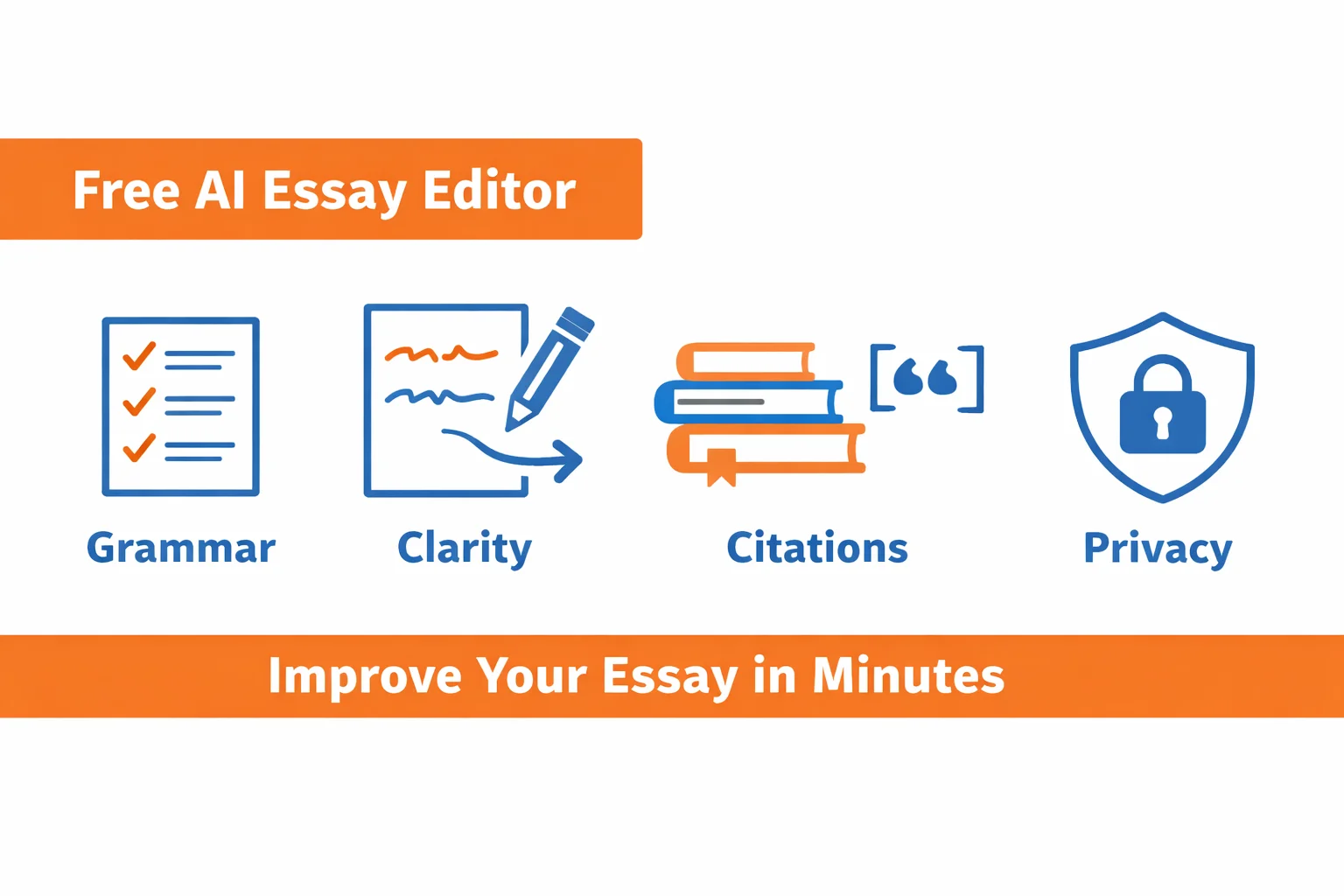
Finding a truly useful AI essay editor online free can feel confusing: many tools advertise “free,” but hide key features (rewrites, citation help, plagiarism checks) behind trials, caps, or paywalls. This guide breaks down what free AI editors can realistically do for grammar, clarity, academic tone, structure, and citations, how to use them efficiently in minutes, and how to stay aligned with academic integrity and privacy expectations.
Quick start: how to use a free online AI essay editor in 10 minutes
If you’re under deadline, the goal is to prioritize the edits that move your grade or acceptance odds: clarity, correctness, citations, and coherence.
10-minute workflow (repeatable)
- Pick one “core editor” + one “clarity tool.”
Example: LanguageTool for grammar + Hemingway for readability. - Paste 1–3 paragraphs at a time (helps stay under free limits).
- Run grammar/spelling first, accept only high-confidence fixes (typos, punctuation).
- Run clarity/style suggestions, but keep your voice (avoid over-rewrite).
- Rewrite only high-impact sections: thesis, topic sentences, conclusion.
- Check citations and references (format + completeness).
- Final human pass: verify facts, quotations, numbers, and any discipline-specific terms.
Copyable prompt templates (for AI writing correctors / editors)
Use these with tools that support prompts or “rewrite” instructions:
Academic tone + concision
“Edit this paragraph for formal academic tone, reduce wordiness, and keep the original meaning. Do not add new claims.”
Transitions and cohesion
“Suggest improvements to cohesion and transitions between paragraph 2 and paragraph 3. Keep content unchanged.”
Precision + hedge weak claims
“Identify ambiguous or overconfident claims and propose more precise alternatives. Add [citation needed] where appropriate.”
Top free AI essay editors and proofreading tools online (with comparison)
Below is a practical comparison of popular tools students and researchers use for free AI essay proofreading and editing. “No sign-up” and “privacy notes” matter if you’re working with graded coursework, unpublished research, or sensitive content.
Note: Feature availability can vary by region and plan updates. Always confirm on the official product page.
| Tool | Free tier limits | Core strengths | Best for | No sign-up | Plagiarism check | Citation support | Privacy notes |
|---|---|---|---|---|---|---|---|
| Grammarly | Free grammar; advanced rewrites mostly paid | Polished UX, strong general proofreading | Fast grammar/clarity | No | Paid add-on | Limited | Cloud-based; review policy/settings |
| QuillBot | Caps on paraphrase length/modes | Paraphrasing + basic grammar | Rephrasing + citations | Partly | Limited/paid | Yes (tools vary) | Cloud-based; avoid sensitive text |
| LanguageTool | Limited advanced suggestions | Multilingual + style hints | Grammar + formal tone | Often yes | No | No | Offers privacy-focused messaging; check plan details |
| Hemingway Editor | Free web readability checker | Readability and concision | Simplifying dense writing | Yes | No | No | Text processed in browser workflow; still avoid sensitive data |
| ProWritingAid | Free is limited | Deep style reports | Stylistic diagnostics | No | No | No | Account-based for many features |
| Trinka AI | Limited/free trial style | Academic English focus | Research-style polish | No | No | Limited | Designed for academic writing; check data policy |
| Writefull | Feature caps | Academic phrasing patterns | Paper sections (IMRaD) | No | No | No | Research-oriented; check retention terms |
| Paperpal | Free caps on edits | Academic language + structure feedback | Journal-style polish | No | No | Limited | Research workflow focus; verify policies |
| Ginger | Limits on advanced features | Grammar + rephrasing | Basic correction | No | No | No | Extension-based; check permissions |
| Google Docs | Built-in suggestions | Collaboration + basic grammar | Group editing | No | No | No | Enterprise/education settings vary; see Google account policies |
| WPS AI | Free tier edits; short-term pay-per-use | AI editing integrated in Word, PPT, Excel | Grammar, clarity, academic-style polish | No | No | Limited | Supports short-term usage without subscription; check retention |
Individual tool details
Grammarly: fast grammar and clarity for general essays
- Best for: quick grammar, tone, and clarity improvements in coursework.
- Free limitations: fewer rewrite options; plagiarism checking is not typically part of the free experience.
- Tip: use it for your final pass to catch surface-level errors after you’ve finalized content.
Official tool: Grammarly
QuillBot: paraphrasing and citation support
- Strengths: paraphrasing modes, grammar check, and citation-related utilities that help with formatting basics.
- Free limitations: character caps and fewer paraphrase modes.
- Tip: paraphrase only sentences you genuinely want to restructure, then run grammar checks and compare meaning carefully.
Official tool: QuillBot
LanguageTool: privacy-focused grammar and style
- Strengths: strong multilingual grammar checking and useful style suggestions.
- Free limitations: fewer advanced suggestions and shorter checks depending on plan.
- Tip: enable formal or academic style hints when available, then review each change manually.
Official tool: LanguageTool
Hemingway Editor: readability and concision
- Strengths: highlights long sentences, passive voice, and readability issues—excellent for tightening academic writing.
- Free limitations: not a full grammar checker and not a generative AI rewriter.
- Tip: use after grammar fixes to simplify sentences without changing meaning.
Official tool: Hemingway Editor
ProWritingAid: stylistic depth and reports
- Strengths: deeper style insights (repetition, sentence variety, transitions) that can help with flow.
- Free limitations: restricted reports or word count limits.
- Tip: run targeted reports only on the introduction and conclusion to maximize value.
Official tool: ProWritingAid
Trinka AI: academic English for research papers
- Strengths: positioning as an academic writing assistant—useful for formal tone, consistency, and discipline-leaning phrasing.
- Free limitations: typically trial/caps.
- Tip: prioritize abstracts, introductions, and discussion sections where tone matters most.
Official tool: Trinka AI
Writefull: academic phrasing and discipline-aware suggestions
- Strengths: research-oriented phrasing support (useful for methods/results conventions).
- Free limitations: caps; best value when applied to specific sections rather than whole papers.
- Tip: use it to standardize phrasing (e.g., “We evaluated…”, “Results indicate…”) while keeping your findings intact.
Official tool: Writefull
Paperpal: journal-style polish and structure guidance
- Strengths: geared toward academic writing quality; helpful for clarity and submission polish.
- Free limitations: limited runs or word caps.
- Tip: use it for “final polish” rather than early drafting to avoid over-editing.
Official tool: Paperpal
Ginger: grammar with rephrasing
- Strengths: quick grammar corrections plus rephrase/synonyms.
- Free limitations: daily caps and fewer advanced options.
- Tip: use rephrasing for repetitive phrasing, then check that citations and terminology remain correct.
Official tool: Ginger
Google Docs: built-in grammar and collaboration
- Strengths: easy collaboration, comment workflows, and built-in spelling/grammar suggestions.
- Free limitations: limited academic tone control and no true plagiarism database.
- Tip: use “Suggesting” mode for transparent edits in group work, and confirm how grammar suggestions work in Google’s help docs like Check your spelling & grammar in Google Docs.
Official tool: Google Docs
WPS AI: AI editing integrated in Word, PPT, Excel
- Strengths: AI-powered editing directly within Word, PowerPoint, and Excel; supports grammar, clarity, and academic-style improvements.
- Free limitations: free tier may have limited edits; supports short-term pay-per-use without subscription.
- Tip: use for targeted sections where in-app AI editing saves time, and benefit from seamless integration across office documents.
Official tool: WPS AI
Free vs. paid: what you actually get in AI essay editors
Free tools cover the “surface correctness” layer well. Paid tiers typically cover the “submission readiness” layer: deeper rewrites, citations, and plagiarism/similarity features.
Free vs paid (practical comparison)
| Capability | Free tier (typical) | Paid tier (typical) |
|---|---|---|
| Grammar & spelling | Strong | Strong |
| Clarity rewrites | Limited | Extensive (document-wide) |
| Academic tone control | Basic/limited | Advanced, domain-specific |
| Structure/cohesion feedback | Light | Deeper reports and guidance |
| Plagiarism/similarity | Often missing or limited | More complete databases/features |
| Citation validation | Formatting help only | Broader tools + deeper checks (varies) |
| Export/versioning | Basic | Better workflows, history, integrations |
Decision factors (what matters most)
- Assignment stakes: coursework vs. thesis vs. journal submission
- Need for citations and similarity checks: higher stakes → more important
- Document length: longer papers hit free caps quickly
- Privacy constraints: avoid uploading confidential or embargoed content
- Budget + frequency: occasional use may not justify annual plans
Short-term access options for occasional needs
If you only need premium features for a single submission window (e.g., deep academic tone tuning or a one-time premium editor feature), consider:
- Official free trials from the tool provider
- Monthly plans instead of annual subscriptions
- Time-limited activation codes for compatible productivity software where appropriate (for example, ShortKey explains the model in How short-term software access works and operational steps in Using short-term activation codes).
If you go this route, treat it like software procurement: confirm compatibility, terms, and privacy handling before you upload any academic work.
Secure and ethical use: privacy, integrity, and policy alignment
Using AI tools for editing is increasingly common, but expectations are tightening around transparency, authorship, and responsible AI use.
Privacy and data handling (Do/Don’t checklist)
Do
- Review retention/training settings, opt-outs, deletion controls, and account-level privacy options.
- Remove personal identifiers, student IDs, unpublished participant data, or confidential client information.
- Prefer tools and workflows that minimize exposure (e.g., edit in chunks, avoid full datasets).
Don’t
- Upload confidential research manuscripts or proprietary datasets without permission.
- Paste peer-reviewed-but-embargoed content into tools that may retain or learn from inputs.
- Assume “free” equals “private.”
For organizational risk framing, consult standards like the NIST AI Risk Management Framework (AI RMF 1.0) and high-level norms like the OECD AI Principles.
Academic integrity: what’s usually acceptable vs. risky
Generally acceptable (in many contexts):
- Grammar correction, spelling, punctuation
- Clarity edits that preserve meaning
- Formatting citations (with verification)
High-risk (often disallowed or requires disclosure):
- Generating new arguments, literature reviews, or claims you cannot verify
- “Citation invention” (fabricated sources)
- Submitting AI-generated text as original thinking
Publishing ethics organizations have been explicit that AI tools should not be treated as authors. See the COPE position statement on Authorship and AI tools.
Plagiarism vs similarity vs detection (and why tools can mislead)
Plagiarism is not simply “text overlap.” The U.S. Office of Research Integrity defines and discusses plagiarism in research policy terms in its ORI policy on plagiarism. Practically:
- Similarity tools flag overlap; they do not decide intent or misconduct.
- AI detectors can be unreliable and may produce false positives, especially across different writing backgrounds. Peer-reviewed evidence includes the Patterns paper, GPT detectors are biased against non‑native English writers.
- Even vendors caution against overreliance. Turnitin’s documentation notes limitations and positioning of AI detection within its workflow: AI writing detection overview and limitations.
Practical workflows: free AI essay proofreading for common scenarios
Coursework essay (1500–2500 words)
A reliable “stack” without paying:
Grammar pass: LanguageTool or Grammarly
Readability pass: Hemingway Editor to reduce sentence length and clarify phrasing
Academic polish (limited free runs): Writefull, Trinka AI, Paperpal, or WPS AI
Citations: generate/format with tools where available, then verify against official style guidance:
- APA Style: How to cite ChatGPT and generative AI
- MLA Style Center: Citing generative AI (updated and revised)
- For Chicago-style overviews, library guidance can help interpret current rules, e.g. Chicago (CMOS 18th): How to cite generative AI (McMaster University)
Research paper section (Introduction/Discussion)
Focus on sections where language quality changes perceived rigor:
- Draft normally (your claims, your structure).
- Run an academic-focused editor (limited free): Paperpal, Trinka AI, or WPS AI
- Run style diagnostics (if you have access): ProWritingAid to find repetition and weak transitions
- Manually verify: every statistic, DOI, and citation
Last-minute revision (60–90 minutes)
- Fast grammar sweep: Grammarly or LanguageTool
- Readability triage: Hemingway Editor (fix the worst red/purple highlights first)
- If you need premium-only features briefly: choose an official trial/monthly plan, or time-limited access where appropriate—then apply it only to the highest-impact paragraphs to minimize time and privacy exposure.
Choosing the best free AI essay editor for your needs
Use this decision checklist to avoid wasting time on the wrong “free” tool.
Decision checklist
- Need no sign-up?
Start with Hemingway Editor and check whether LanguageTool offers an interface that fits your workflow. - Need academic tone?
Try Trinka AI, Writefull, Paperpal, or WPS AI within free caps. - Need broad grammar + ease?
Grammarly, Ginger, or LanguageTool. - Need readability simplification?
Hemingway Editor. - Need citation help?
Use QuillBot for tooling support, then verify with official guidance (APA/MLA/Chicago links above). - Need occasional similarity checks?
Treat them as screening only and document your process; never rely on a single tool outcome for integrity judgments.
Mini-matrix (quick pick)
- Short essay + tight deadline: Grammarly/LanguageTool → Hemingway
- Long essay + limited free caps: Edit in chunks with LanguageTool → Hemingway → one academic tool pass (Writefull/Trinka AI/Paperpal/WPS AI)
- Research tone (IMRaD sections): Writefull/